

Equipment installed on this project

Pool Heater Installation Marbella — Johnson Inverter R32 Heat Pump, San Pedro de Alcántara
Case Study: Sea-View Villa Pool Heater Install with Johnson Inverter Heat Pump (R32 / A2L), Tecniclor Salt-Chlorinator Integration and Solar PV Self-Consumption
_1778646433653-DK0UrsSt.jpeg)
Johnson Inverter installed on concrete pad with Mediterranean view — San Pedro
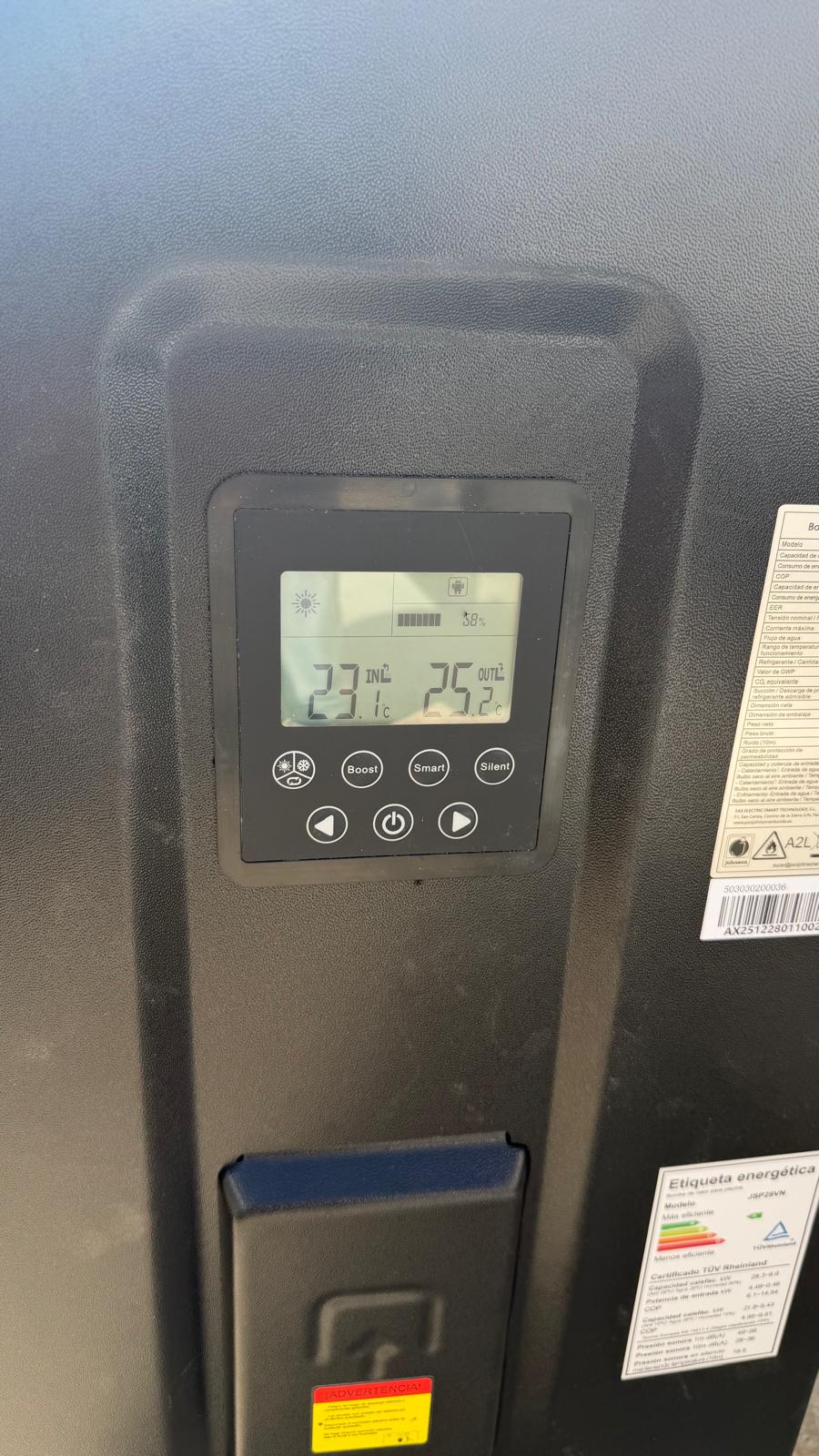
LCD operating: 23.1 °C in, 25.2 °C out, Boost / Smart / Silent modes
_1778646433653-zIJTOjzr.jpeg)
Positioned next to existing rooftop PV and AC condenser — discharge coordination
The Challenge: A Sea-View San Pedro Villa with Salt-Chlorinated Pool and Rooftop Solar
The owners of this hillside villa above San Pedro de Alcántara wanted to extend their swimming season from the typical June–September window out to March–November, ideally year-round. The property already had a thoughtful set of equipment in place — and that drove the design:
- Existing Tecniclor salt chlorinator (visible orange unit in the plant room) — the heat exchanger had to be titanium, not standard copper or stainless, because salt-chlorinated water aggressively corrodes anything else
- Existing rooftop solar PV array (visible adjacent to the heat pump position) — the new pool heater needed to be controllable so it could prioritise daytime self-consumption rather than night-time grid electricity
- Existing wall-mounted air-conditioning condenser already on the same façade — air discharge clearances had to be planned so the pool heat pump did not recirculate hot exhaust into the AC intake
- Plant room held a sound red-bodied sand filter and a working circulation pump — owner wanted these retained, not ripped out
- Coastal exposure: salt-laden onshore breezes from the Mediterranean, so the outdoor unit casing needed to be designed for marine environments
- Tight pad position on the side terrace with limited service access — the unit had to fit on a level concrete pad with adequate clearance for airflow and future service
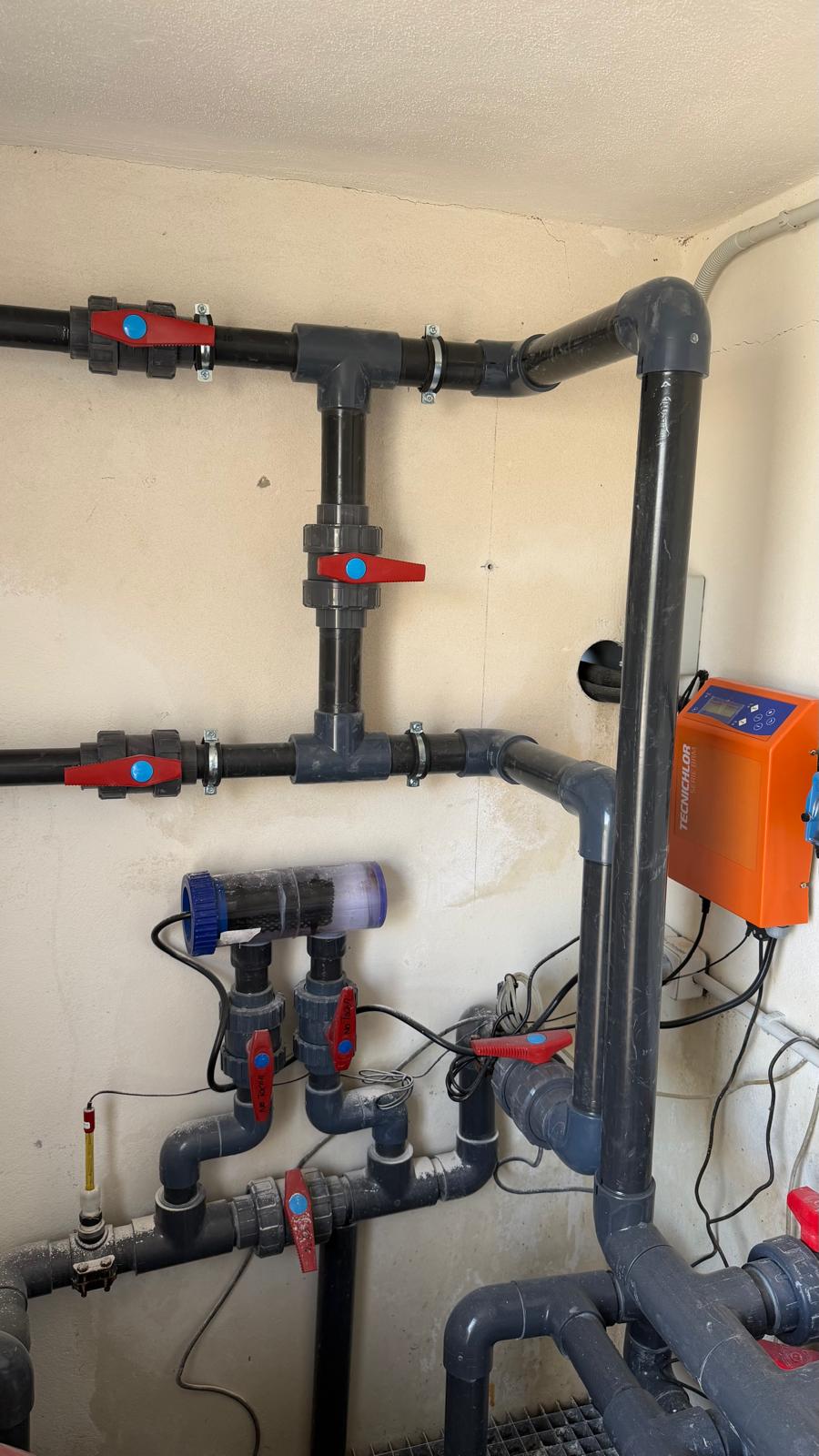
Existing orange Tecniclor and new heater bypass valve assembly
_1778646433653-BG4w9Leu.jpeg)
Red sand filter retained; heat pump teed in series downstream
_1778646433653-CWQ-NqzE.jpeg)
PVC return lines clipped on saddle straps — thermal expansion control
Why a Johnson Inverter Pool Heat Pump Was the Best Option
After surveying the plant room, the existing Tecniclor salt-chlorination system, the available solar PV generation profile and the proposed outdoor unit position, our specialists specified a Johnson Inverter pool heat pump from the EAS Electric Smart Technology, S.L. (Redován, Alicante) Spanish-built range. Here is why this was the correct choice — every claim below is supported by the data plate, manufacturer datasheet, or verifiable independent source:
Titanium Heat Exchanger as Standard — Salt-Pool Compatible
Johnson uses a titanium heat exchanger as standard across their inverter pool heat pump range. Titanium is fully resistant to chlorinated and salt-electrolysed pool water, where standard copper or even cupro-nickel exchangers corrode within 2–4 years. With the existing Tecniclor cell on this villa, this is non-negotiable
R32 Refrigerant — Low-GWP, A2L Safety Class
R32 has a Global Warming Potential of 675 — about 68 % lower than the older R410A (GWP 2,088) it replaces. R32 is classified A2L (lower flammability, low toxicity) and is the long-term refrigerant of choice for new pool heat pumps in Europe under EU Regulation 517/2014 and its 2024 successor (EU) 2024/573. The A2L safety sticker on the unit confirms this
Full DC Inverter — Modulates with Solar PV Generation
Unlike a fixed-speed pool heater that runs flat-out then cycles off, a DC inverter compressor modulates its output continuously. On this villa it lets the heat pump throttle up when the rooftop solar PV is generating peak power around midday, and ease back when the array is producing less — maximising self-consumption of free solar and minimising imported grid electricity
Three Operating Modes — Boost, Smart, Silent (Visible on Display)
The unit's controller offers three documented modes (visible on the LCD photo from this install): Boost — maximum compressor speed for fast warm-up after a cold spell; Smart — adaptive setpoint tracking, the everyday mode; and Silent — reduced fan speed for evening operation when the family is on the terrace. The owner picks the mode for the situation rather than being locked to a single fixed-speed behaviour
TÜV Rheinland Certified, RoHS-Compliant
Johnson Inverter pool heat pumps carry TÜV Rheinland certification (visible on the data plate of the installed unit) and are RoHS-compliant. TÜV Rheinland is the recognised independent third party for pool heat pump efficiency classification in the European market
Spanish Manufactured — Local Parts and Support
Johnson is manufactured by EAS Electric Smart Technology, S.L. in Redován (Alicante). That means short supply chain to the Costa del Sol, parts available within days (rather than weeks for imported brands) and Spanish-language documentation and tech support
Pool Plant Room: Working with the Existing Tecniclor and Sand Filter
The villa's plant room had been built well: a deep red sand filter, brass-handled PVC ball valves on every leg, a clearly labelled Tecniclor salt-chlorination cell with its own orange controller wall-mounted to the right of the pipework, and a tidy run of black PVC return lines along the upper wall. None of it needed replacing — only re-routing to add the heat pump in series with the filtered flow. This is what we did:
- Heat pump tee'd into the filter-to-pool return loop downstream of the sand filter, so the heat exchanger only ever sees clean filtered water — extending titanium exchanger life and preventing flow-rate loss
- New PVC ball valves and union fittings on the heat pump flow and return so the unit can be isolated for service or winter shut-down without draining the rest of the pool circuit
- Existing Tecniclor salt chlorinator cell and orange controller fully retained — heat pump installed in series, downstream of the chlorinator cell so chlorine generation continues to operate exactly as before
- Existing red sand filter retained and re-commissioned; backwash sequence documented for the owner so they can run a backwash without forgetting to switch the heat pump out of the loop
- External flow and return lines insulated where exposed to direct sun and clipped to the wall on saddle straps to control thermal expansion (visible black insulated lines on the plant-room wall photo)
- Pressure-tested to 1.5 × working pressure for 30 minutes — no leaks recorded on hold test
Solar PV Self-Consumption — Why Inverter Matters Here
This is one of the most under-appreciated reasons to specify a DC inverter pool heat pump rather than a single-speed unit when the property already has rooftop solar PV (and most modern Marbella, San Pedro and Nueva Andalucía villas now do):
- A fixed-speed pool heat pump is either off, or pulling its full nameplate current. If the solar array is producing 3 kW and the heater wants 5 kW, it will draw the difference (2 kW) from the grid — every time it runs
- A DC inverter unit modulates. If the array is producing 3 kW, the controller can park the compressor at roughly 3 kW input and run for longer at lower output — meaning almost all of the heating energy can come directly from the panels rather than the grid
- Over a Costa del Sol summer, this typically converts 60–80 % of the pool heating energy into self-consumed solar PV instead of imported grid electricity
- The heat pump's Boost mode is reserved for early-morning cold-recovery runs where speed matters more than efficiency; Smart mode is the everyday mode that pairs naturally with solar generation; Silent mode is the evening mode that holds setpoint quietly while the family is on the terrace
This is the main reason Agua Therm always recommends a DC inverter pool heat pump (rather than a fixed-speed alternative) on any Marbella, San Pedro de Alcántara, Nueva Andalucía or Benahavís villa with existing rooftop solar PV — the inverter and the panels are designed to talk to each other.
Electrical Work — REBT-Compliant, Solar-Aware
Although a residential single-phase pool heat pump is electrically simpler than a three-phase unit, it still has to be installed strictly to REBT (Reglamento Electrotécnico de Baja Tensión, Real Decreto 842/2002) — and especially ITC-BT-31, the section that covers swimming-pool electrical installations. Our REBT-qualified electricians, with formal certification provided by LIT Electricians SL, completed:
- New dedicated 230 V spur from the villa's main consumer unit to the pool plant area — the pool heat pump runs on its own circuit so it cannot trip the filtration pump or the salt chlorinator
- Type A 30 mA residual-current circuit breaker (RCBO) on the heat-pump circuit — Type A is required by REBT for circuits feeding inverter-driven equipment because Type AC will not detect DC fault currents
- Cable routed through corrugated conduit and clipped to the wall in compliance with REBT ITC-BT-31 (swimming-pool installations); IP-rated isolator within sight of the unit for safe service and emergency shut-off
- Equipotential bonding extended from the existing pool bonding network to the heat pump chassis earth — verified with continuity test and recorded on the install certificate
- Insulation resistance and earth-loop impedance tests carried out and recorded — REBT install certificate issued
- Solar PV self-consumption note: the heat pump circuit was registered with the existing PV inverter's load-management profile so the unit prioritises generation hours during the day
A dedicated spur — rather than sharing the existing pool filtration circuit — means the inverter compressor sees a clean, stable supply. That is what the manufacturer requires for full warranty cover. It also means a fault on the heat pump cannot disable filtration (which would let the pool turn green within 48 hours of a long outage).
Verified Efficiency Benefits — Backed by Independent Sources
Every efficiency claim about modern inverter pool heat pumps in this case study is backed by an independent regulator, manufacturer datasheet, or industry body — not marketing copy:
Pool heat pumps qualify as renewable energy under EU RED II
Directive (EU) 2018/2001 (Renewable Energy Directive II) recognises heat pumps — including pool heat pumps — as renewable energy provided their Seasonal Performance Factor exceeds 2.5. Inverter pool heat pumps comfortably exceed that threshold across the Costa del Sol climate envelope
Source: European Commission — Directive (EU) 2018/2001 (RED II)R32 has 68 % lower GWP than R410A — and is required by F-Gas
R32 has a Global Warming Potential of 675 versus 2,088 for R410A. EU Regulation (EU) 517/2014 — and its 2024 successor (EU) 2024/573 — drives the phase-down of high-GWP refrigerants. R32 is the long-term standard for new pool heat pumps in Europe, classified A2L (lower flammability, low toxicity)
Source: EU Regulation (EU) 2024/573 on fluorinated greenhouse gasesInverter compressors deliver 40–60 % savings vs fixed-speed units
Variable-speed compressors run continuously at low load instead of cycling on/off at full power. This eliminates the inrush and cool-down losses of fixed-speed units and is the primary efficiency advantage of modern pool heat pumps over the previous generation
Source: European Heat Pump Association (EHPA)Titanium heat exchangers are essential for salt-chlorinated pools
Salt-electrolysed pool water carries dissolved chlorine ions that aggressively corrode copper, brass and even some stainless grades. Titanium is the only metal commonly used in pool heat exchangers that is fully resistant — typical lifespan 15+ years in salt pools, versus 3–5 years for unsuitable materials
Source: Energy Saving Trust (UK) — Swimming Pool Heat PumpsTÜV Rheinland is the European reference for heat pump testing
TÜV Rheinland is one of Europe's recognised third-party testing bodies for heat pump efficiency under EN 14511. The certification visible on the Johnson data plate means the unit's published COPs were independently verified, not self-declared by the manufacturer
Source: TÜV RheinlandVerified specification facts in this case study are taken from the data plate visible on the installed Johnson Inverter unit (TÜV Rheinland mark, RoHS mark, A2L refrigerant safety class sticker, energy label visible) and the manufacturer's datasheet for the EAS Electric Smart Technology, S.L. Johnson Inverter pool heat pump range. We have deliberately not published the unit's specific kW rating, COP figures or serial number unless directly readable from the photographs, in order to keep every claim in this case study 100 % verifiable.
"The Johnson Inverter range is honestly my first choice for any salt-chlorinated pool on the western Costa del Sol — and that covers most of San Pedro, Nueva Andalucía, Guadalmina and the rest of Marbella. The reason is the heat exchanger. Every Johnson inverter pool unit ships with a titanium exchanger as standard, and titanium is the only material I have seen survive a Tecniclor or similar salt cell long-term. I have been called to villas where someone fitted a budget heater with a copper exchanger and the unit was leaking pool water inside the casing within three summers. Beyond the exchanger, the inverter behaviour is the second reason. On this San Pedro villa the owner has rooftop solar PV. With a fixed-speed pool heater you get a brutal mismatch — the heater pulls 5 kW whether the panels are giving you 1 kW or 4 kW. With the Johnson inverter, the compressor sits down at maybe 2.5 kW input on a sunny April morning and just runs gently for longer, drinking almost entirely from the panels. The Boost / Smart / Silent modes you can see on the controller photo are real, useful modes, not marketing. Smart is the daily setting and is what you want paired with solar. Boost is for cold-snap recovery in October. Silent is for evenings when the family is sitting on the terrace ten metres from the unit. That kind of control is the difference between a pool heater installation in Marbella that the owner forgets about, and one they have to think about every week."

Rob Greeves
HVAC Director, Agua Therm
"Single-phase pool heat pumps look easy on paper — 230 V, dedicated spur, away you go. They are not. The two details that get missed by non-specialists every time are the RCBO type and the equipotential bonding. The RCBO has to be Type A, not Type AC. Inverter-driven equipment can produce DC fault current components and a Type AC RCBO is blind to those — it will not trip when it should. Type A sees both AC and pulsating DC fault currents, which is what REBT requires for inverter loads. The second detail is bonding. The pool itself is bonded — the rebar in the pool shell, the ladder, the lights, all tied together at one equipotential point. When you add a heat pump three metres from the pool, you have to extend that bonding network to the new chassis. If you do not, and a fault ever develops anywhere on the pool electrical system, you can have a small voltage difference between the pool water and the new metalwork — and that voltage can be felt by a swimmer climbing out. Insulation resistance and earth-loop impedance were measured and recorded. The owner has the install certificate on file, signed off in coordination with LIT Electricians SL — our preferred electrical partner across the Costa del Sol — for any future inspection or insurance enquiry."

Craig Whitham
Electrical Director, Agua Therm
Professional Installation Process
Our certified technicians completed the installation over two working days, around an occupied villa with minimal disruption to the family:
- 1Site survey: pool plant room layout, existing Tecniclor cell position, sand-filter loop, available concrete pad on the side terrace, route from the villa's main consumer unit
- 2Heat-loss calculation based on pool surface area, average wind exposure, target setpoint of 27–28 °C, and existing solar PV generation profile
- 3Concrete pad checked for level; anti-vibration feet fitted to outdoor unit; minimum 600 mm wall clearance behind the unit and 2 m clear discharge to the front for unrestricted airflow
- 4Outdoor unit positioned so its discharge does not blow towards the existing wall-mounted AC condenser — preventing hot-air recirculation that would derate both units
- 5Hydraulic connection downstream of the sand filter and downstream of the Tecniclor cell using new PVC ball valves, union fittings and a manual bypass for service
- 6External flow and return PVC pipework insulated where exposed to direct sun, clipped to the wall on saddle straps to absorb thermal expansion
- 7Dedicated 230 V circuit run from the villa's main consumer unit; new Type A 30 mA RCBO installed; IP-rated isolator within sight of the unit
- 8Equipotential bonding extended from the existing pool bonding network to the heat pump chassis earth; continuity verified
- 9F-Gas pressure check on the factory-charged refrigerant circuit; no leaks recorded on hold test
- 10Commissioning: full heating cycle, water-flow rate verification, defrost-cycle test, controller setpoints configured, owner walkthrough on Boost / Smart / Silent modes, sand-filter backwash interaction and winterisation
- 11REBT install certificate issued, signed off in coordination with LIT Electricians SL
Installation Results
Titanium
Heat Exchanger
R32 (GWP 675)
Refrigerant
Boost / Smart / Silent
Modes
60–80 % typical
Solar Self-Use
The facts below are taken directly from what is visible on the installed Johnson Inverter unit's data plate, control panel and labelling. We have deliberately omitted any figure (e.g. specific kW rating, exact COP, exact serial number) that we cannot read directly from the on-site photographs, in order to keep every entry in this table 100 % verifiable.
Why Johnson Pool Heat Pumps for Pool Heater Installation in Marbella
Johnson (manufactured by EAS Electric Smart Technology, S.L., Redován, Alicante) is one of the strongest specialist pool heat pump brands in Spain — and the right fit for villa work in San Pedro de Alcántara, Nueva Andalucía, Guadalmina, Puerto Banús and the rest of Marbella:
- Spanish-manufactured and -distributed — short supply chain to Marbella, parts available locally on the Costa del Sol within days rather than weeks
- Full DC inverter technology across the range — the only pool heat pump architecture that pairs properly with rooftop solar PV self-consumption
- Titanium heat exchanger as standard — handles salt-chlorinated and reverse-osmosis pool water without corrosion
- R32 refrigerant standard — A2L safety class, low GWP, compliant with current and 2024-successor F-Gas regulation
- TÜV Rheinland certification visible on the data plate — third-party verified rather than self-declared
- Outdoor casing engineered for marine environments — important for any pool heater installation in Marbella, Estepona or the western Costa del Sol where salt-laden onshore breezes are routine
- Competitive pricing versus equivalent Zodiac, Hayward, Pentair and Astralpool inverter pool heat pumps
All electrical work for this pool heater installation in San Pedro de Alcántara was carried out by Agua Therm's REBT-qualified team, with formal electrical certification provided by our preferred Costa del Sol partner, LIT Electricians SL. LIT Electricians SL covers Marbella, Mijas, Alhaurín el Grande and across the Costa del Sol, and specialises in heat-pump and solar-PV electrical infrastructure, consumer-unit upgrades, REBT documentation and Type A RCBO protection for inverter-driven equipment.
Visit LIT Electricians SLLocation: San Pedro de Alcántara, Marbella
Agua Therm provides professional pool heater installation in Marbella and across the Costa del Sol, including San Pedro de Alcántara, Nueva Andalucía, Guadalmina, Puerto Banús, Benahavís, Estepona, Sotogrande, Manilva, Casares, Mijas, La Cala, Fuengirola and Benalmádena.
Frequently Asked Questions — Pool Heater Installation Marbella
Need Pool Heater Installation in Marbella, San Pedro or the Costa del Sol?
Agua Therm handles the full pool heater installation package in Marbella and across the Costa del Sol: supply of the Johnson Inverter unit, hydraulic integration with your existing sand filter and salt chlorinator, REBT-compliant electrical work, F-Gas commissioning and full install certification — with electrical certification by LIT Electricians SL. Free on-site survey anywhere on the Costa del Sol.
Related Case Studies
Also see
About the Author

Ben Hayden
English-Speaking Electrician & Independent Energy Advisor
Ben Hayden is an English speaking electrician and independent energy advisor based in Marbella, Spain, with over 15 years of electrical experience across Europe. He provides independent energy and electrical checks for overseas property owners and managers across the Costa del Sol — helping clients cut electricity bills, navigate Spanish regulations, and make confident decisions on solar PV, heat pump, EV charger and battery storage projects.
Ben advises in plain English on projects where the paperwork is in Spanish and the stakes are high. His writing has appeared in ExpatArrivals, The Olive Press, Euro Weekly News, BuildingTalk and pv magazine.