

Underfloor Heating Retrofit Spain 2026: Wet vs Dry Systems, €9,200-€25,000 Costs
Complete UFH Retrofit Guide • Wet vs Dry System Comparison • €6,000 IDAE Subsidies • 1-4 Week Installation • Mediterranean Climate Optimization
Underfloor heating retrofit transforms Spanish homes with radiant comfort and 40-70% energy savings versus traditional radiators, but choosing between wet and dry systems critically determines success or €15,000 failure. Wet systems (€14,500-€18,000 for 100m²) embed pipes in 65mm screed requiring 3-4 week evacuation but deliver 50+ year lifespan and optimal thermal mass for poorly insulated buildings. Dry systems (€11,200-€13,500) install over existing floors in 1-2 weeks with only 18mm height increase, perfect for low ceilings, occupied properties, and Mediterranean rapid temperature response. Real Costa del Sol case studies show massive variation: Marbella villa success (€18,500 wet system, 68% energy savings, COP 4.2 with heat pump), versus Coín cortijo failure (€15,000 wasted installing UFH before fixing poor insulation, COP 2.1, €320/month running costs). IDAE 2025 subsidies reward smart retrofits: €2,000-€3,000 UFH-only or €6,000-€7,000 combined with heat pump installation - the Estepona villa received €6,000 for integrated system. Critical pre-retrofit assessment prevents common €5,000-€15,000 mistakes: Insulation upgrade required for pre-1990 buildings (single glazing, uninsulated walls), ceiling height measurement (<2.5m = dry system only), tile preservation strategy (dry can install over expensive marble), and heat pump integration timing (combined install unlocks higher subsidies plus lower labor costs). Mediterranean climate favors dry systems for 9 out of 10 retrofits: 20-minute warm-up versus 4-6 hours wet system matches Costa del Sol's variable winter weather (8°C mornings, 18°C afternoons), room-by-room zoning ideal for intermittent heating, and lightweight construction (30kg/m²) suits timber upper floors in townhouses. Agua Therm installs both wet and dry underfloor heating systems across all 103 Málaga municipalities with pre-retrofit insulation assessment and heat pump integration COP optimization reaching 4.5-4.8 efficiency in Mediterranean climate.
Important disclaimer — Information changes daily
Subsidy amounts, eligibility criteria, deadlines, and programme availability can change without notice. Information on this page is provided as a general guide only and may not reflect the current status of grant programmes.
Agua Therm is an installation company only. We do not handle subsidy applications, IRPF tax deductions, IBI/ICIO municipal applications, or any grant paperwork. We strongly recommend speaking with an independent subsidy specialist before committing to any installation, so you are fully informed of the options available at that time.
Wet vs Dry Systems: Complete Comparison
25 critical factors compared to help you choose the right system for your Spanish property
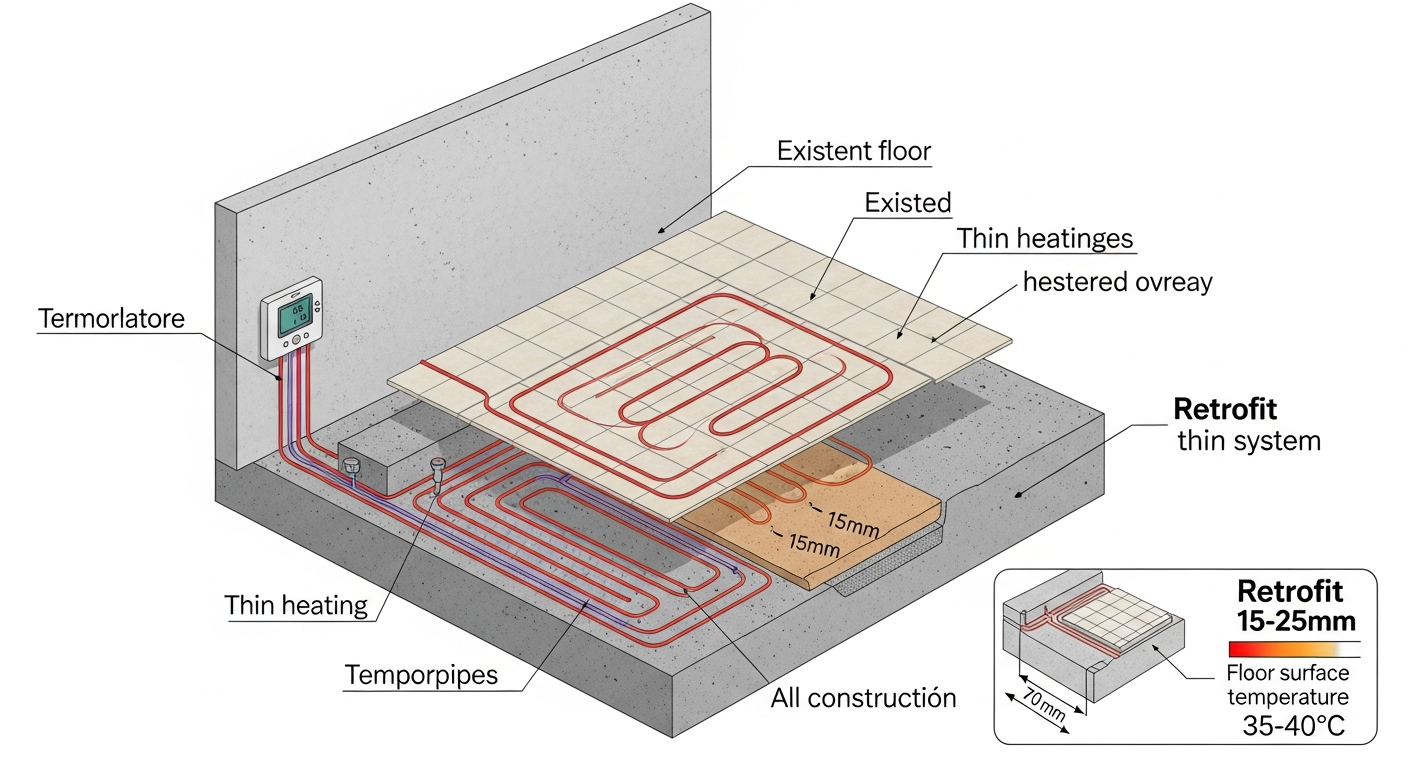
| Feature | Wet System | Dry System | Winner |
|---|---|---|---|
| Response time (cold to warm) | 4-6 hours | 15-30 minutes | |
| Floor height increase | 65-85mm | 18-35mm | |
| Installation cost per m² | €90-€140 | €70-€110 | |
| Installation time (100m² property) | 3-4 weeks | 1-2 weeks | |
| Mediterranean climate suitability | Good (slow response for rapid temp changes) | Excellent (rapid response ideal for mild winters) | |
| Heat pump compatibility | Excellent - optimal low-temp operation | Excellent - optimal low-temp operation | ≈ |
| Running costs (same insulation) | Identical efficiency | Identical efficiency | ≈ |
| Ceiling height impact | Significant (65mm+ reduces 2.5m to 2.435m) | Minimal (18mm barely noticeable) | |
| Disruption level during installation | High - usually must vacate property | Medium - can live in property room-by-room | |
| Existing tile preservation | Tiles must be removed and replaced | Can install over existing tiles in many cases | |
| Heat distribution uniformity | Excellent - water distributes heat evenly | Very good - slight variations possible | |
| Thermal mass (heat retention) | High - stays warm hours after shutdown | Low - cools quickly when off | |
| Suitability for cooling mode | Good - high thermal mass prevents condensation | Fair - requires careful humidity control | |
| Maximum heat output (poorly insulated buildings) | Higher - can handle greater heat loads | Lower - best for well-insulated properties | |
| Underfloor weight loading | 150-180 kg/m² (screed + water) | 25-40 kg/m² (boards + minimal screed) | |
| Suitability for timber upper floors | Difficult - weight and wet screed issues | Ideal - designed for timber joists | |
| Leak risk over lifetime | Low but present (pipe damage, corrosion) | Minimal (no water in floor) | |
| Longevity / lifespan | 50+ years (concrete encased pipes protected) | 30-40 years (depends on board quality) | |
| Retrofit over underfloor heating existing | Cannot retrofit over existing UFH | Can add over failed/inadequate systems | |
| Suitability for stone/marble floors | Excellent - high conductivity maximized | Good but not optimal for stone | |
| Repairability if fault develops | Difficult - requires floor excavation | Easier - can access from above in many cases | |
| Sound insulation impact | Improved - screed adds mass for soundproofing | Neutral - minimal acoustic benefit | |
| DIY installation possibility | Not recommended - specialist skills required | Possible for competent DIYers (not advised) | |
| Compatibility with solid concrete floors | Ideal - designed for concrete slabs | Good but requires careful installation | |
| Energy efficiency (SCOP with heat pump) | 4.0-4.8 (optimal at 30-35°C flow temp) | 4.0-4.8 (optimal at 30-35°C flow temp) | ≈ |
Wet System
Best for:
- Solid concrete floors throughout
- Tiles being replaced anyway
- Maximum longevity priority (50+ years)
- Underfloor cooling in summer wanted
Avoid if:
- Low ceilings (<2.5m)
- Need to live in property during install
- Timber upper floors
Dry System
Best for:
- Mediterranean climate (20-min rapid response)
- Low ceilings - only 18mm raise
- Preserve expensive tiles (marble, imported)
- Room-by-room install while occupied
Avoid if:
- Want to install new ceramic tiles directly on top
- Very poorly insulated building (need max heat output)
9 Real Case Studies: Costa del Sol Successes and Failures
Learn from real installations in Marbella, Mijas, Fuengirola, Coín and other Málaga municipalities
Marbella
1980s villa
Challenges:
- • All ceramic tiles had to be removed and replaced
- • 65mm floor height increase required new door thresholds
- • Residents moved out during installation
- • Existing radiator system had to be decommissioned
- • Solid concrete required precise groove cutting for pipes
Solution:
Complete wet system retrofit with Daikin Altherma heat pump integration. 16mm PEX pipes embedded in leveling compound at 150mm spacing. New porcelain tiles installed after system testing. Smart zoning added for four separate areas.
Outcome:
Heating costs reduced by 68% compared to old oil boiler. SCOP 4.2 achieved with heat pump operating at 35°C water temperature. Complete comfort throughout winter with floor temperatures averaging 24°C. Three-year payback period including IDAE subsidy.
Mijas
1995 townhouse
Challenges:
- • Wanted to keep existing upstairs radiators functional
- • Preserve specific imported ceramic tiles if possible
- • Limited ceiling height in hallway (2.35m)
- • Integration with existing Mitsubishi heat pump
- • Uneven floor levels between rooms
Solution:
Dry system installed downstairs using 18mm aluminum diffusion plates to minimize floor height increase. Upstairs radiators kept on separate zone. Existing tiles preserved in living room by installing dry system over them. Hallway used ultra-thin 12mm system.
Outcome:
Best of both worlds achieved. Downstairs comfort with radiant floors (20-minute warm-up time), upstairs keeps quick-response radiators for bedrooms. Total energy consumption down 52%. Original tiles preserved saving €2,400. Ceiling heights maintained.
Fuengirola
2005 apartment
Challenges:
- • Very low ceiling height (2.25m) - cannot afford floor raise
- • Hollow floor construction limits wet system viability
- • Apartment above cannot be disturbed
- • Coastal location requires salt-resistant materials
- • Owner living in property during installation
Solution:
Ultra-low profile dry system with 14mm engineered wood boards containing integrated aluminum channels. Electric mat system in bathroom (not heat pump compatible). Minimal disruption - room by room installation while occupied.
Outcome:
Only 18mm total floor height increase vs 65mm wet system would require. Maintained ceiling height and avoided door modifications. 15-20 minute response time perfect for Mediterranean climate. Owner remained in residence throughout. Heat pump efficiency: COP 3.8.
Coín
1970s cortijo (FAILURE CASE)
Challenges:
- • Single-glazed windows with massive heat loss
- • Uninsulated stone walls (U-value 2.1 W/m²K)
- • No roof insulation
- • Installer did not conduct heat loss assessment
- • System sized for heat loss, not insulation level
Solution:
Wet underfloor heating installed with high-temperature operation (45°C) to compensate for poor insulation. Heat pump struggled with heat demand, reverting to backup electric resistance heater frequently.
Outcome:
COMPLETE FAILURE. Running costs €320/month in winter vs €180 with old system. Heat pump COP only 2.1 due to high water temps needed. Floors never comfortable - heat escaping through walls/windows. Should have spent €8,000 on insulation FIRST, then €10,000 on smaller UFH system. Lesson: retrofit insulation before heating system.
Estepona
Modern villa (new construction comparison)
Challenges:
- • Large open-plan areas requiring precise zoning
- • Pool heating integration wanted
- • Domestic hot water from same heat pump
- • Smart home integration required
- • Optimal pipe spacing for efficiency
Solution:
Daikin Altherma 3H 16kW heat pump with buffer tank. UFH at 100mm pipe spacing for large areas, 150mm for bedrooms. 6 zones with individual thermostats. Pool heat exchanger integrated. All controls via app.
Outcome:
Best-case scenario for UFH. SCOP 4.8 achieved with 32°C flow temperature. Entire home heating + DHW + pool for €95/month average. Floor temperatures perfectly regulated 22-24°C. This is the gold standard - new construction allows optimal installation.
Benalmádena
1990s semi-detached
Challenges:
- • Owner wanted to test UFH before whole-house commitment
- • Bathrooms cold with existing radiator system
- • Limited budget for experimentation
- • Wanted professional installation to assess quality
- • Marble tiles expensive to replace
Solution:
Wet system installed in both bathrooms only. Existing heat pump extended with additional zone valve. 12mm pipes at 100mm spacing for rapid warm-up. Marble tiles carefully removed and reinstalled.
Outcome:
Perfect test case. Bathrooms now warmest rooms in house. Owner so impressed they're planning whole-house retrofit next year (budgeted €14,500). Learned installer quality matters - choosing same company. Smart strategy for risk-averse homeowners.
Nueva Andalucía
2000s penthouse
Challenges:
- • Penthouse location - no outdoor space for traditional heat pump
- • Existing ducted AC wanted to keep for summer cooling
- • Mediterranean climate - rapid temperature response essential
- • Structural loading limits on floor weight
- • Noise concerns for neighbors below
Solution:
Dry system with aluminum diffusion plates and engineered flooring. Fujitsu Waterstage heat pump in plant room. Kept existing AC for cooling. Smart controls adjust to weather forecast for optimal efficiency.
Outcome:
20-minute warm-up time perfect for mild Mediterranean winters. Can heat specific rooms as needed without waiting. Dry system 40% lighter than wet avoided structural concerns. Combined heating costs €78/month. COP 4.1 with 35°C flow temps.
Torremolinos
Coastal apartment
Challenges:
- • 100m from beach - salt air corrosion concerns
- • Existing heat pump already salt-damaged
- • Humidity issues in coastal environment
- • Community rules about noise during installation
- • Wanted to use underfloor cooling in summer
Solution:
Wet system with stainless steel manifolds and corrosion-resistant fittings. New Mitsubishi Ecodan heat pump with coastal corrosion protection coating. Installed dehumidification for cooling mode. All work completed 9am-5pm per community rules.
Outcome:
System designed for 25+ year life in salt environment. Heating in winter (floor temp 23°C), gentle cooling in summer (floor temp 19°C prevents condensation). Coastal-spec heat pump critical - old unit failed after 6 years. New unit warranty: 7 years coastal. Total climate control achieved.
Marbella Golden Mile
1960s villa renovation
Challenges:
- • Heritage-protected terrazzo floors cannot be removed
- • New extension being added with modern standards
- • Wanted consistent comfort throughout
- • Budget constraints after renovation costs
- • Integration with existing solar panels
Solution:
Dry system carefully installed over protected terrazzo in original villa (zero damage). New extension: wet system with optimal pipe spacing. Single heat pump serves both. Solar thermal pre-heats heat pump buffer tank.
Outcome:
Heritage preserved while achieving modern comfort. Dry system over terrazzo works perfectly - no modification to historic floors. Combined system efficiency excellent: SCOP 4.5. Solar integration reduces electricity costs by additional 30%. Property value increased more than retrofit cost.
Complete Cost Breakdown by Room
Detailed material and labor costs to plan your budget accurately
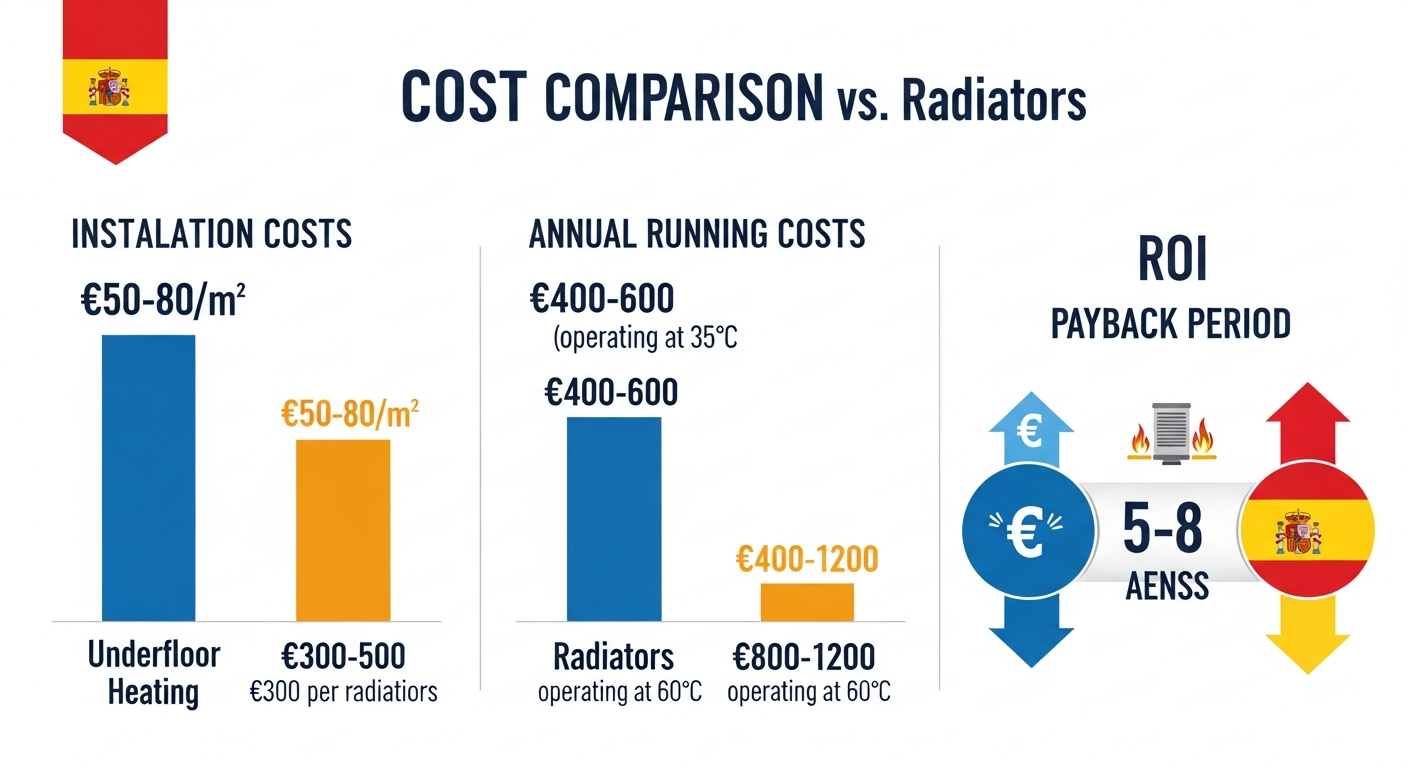
| Room | Size | System | Materials | Labor | Total | Time |
|---|---|---|---|---|---|---|
| Small bathroom | 4m² | Wet system | €320 | €200 | €520 | 1 day |
| Small bathroom | 4m² | Dry system | €240 | €140 | €380 | 0.5 days |
| Medium bathroom | 6m² | Wet system | €480 | €300 | €780 | 1.5 days |
| Medium bathroom | 6m² | Dry system | €360 | €180 | €540 | 0.75 days |
| Small bedroom | 10m² | Wet system | €800 | €500 | €1,300 | 2 days |
| Small bedroom | 10m² | Dry system | €600 | €350 | €950 | 1 day |
| Master bedroom | 15m² | Wet system | €1,200 | €750 | €1,950 | 2.5 days |
| Master bedroom | 15m² | Dry system | €900 | €525 | €1,425 | 1.5 days |
| Kitchen | 12m² | Wet system | €960 | €600 | €1,560 | 2 days |
| Kitchen | 12m² | Dry system | €720 | €360 | €1,080 | 1 day |
| Living room | 25m² | Wet system | €2,000 | €1,250 | €3,250 | 3 days |
| Living room | 25m² | Dry system | €1,500 | €975 | €2,475 | 1.5 days |
| Large open-plan living area | 40m² | Wet system | €3,200 | €2,000 | €5,200 | 4 days |
| Large open-plan living area | 40m² | Dry system | €2,400 | €1,400 | €3,800 | 2.5 days |
| Whole house (3-bed) | 100m² | Wet system | €9,000 | €5,500 | €14,500 | 3-4 weeks |
| Whole house (3-bed) | 100m² | Dry system | €7,000 | €4,200 | €11,200 | 1.5-2 weeks |
| Whole house (4-bed villa) | 150m² | Wet system | €13,500 | €8,250 | €21,750 | 4-5 weeks |
| Whole house (4-bed villa) | 150m² | Dry system | €10,500 | €6,300 | €16,800 | 2-3 weeks |
Dry System
3-bed house (100m²)
Wet System
3-bed house (100m²)
With Subsidy
Combined with heat pump
Decision Framework: Which System is Right for You?
Answer these critical questions to determine the best retrofit approach for your property
Is your building pre-1990?
STOP - Insulation assessment required first
Proceed with retrofit assessment
Explanation:
Pre-1990 Spanish buildings typically lack adequate insulation (single glazing, uninsulated walls, no roof insulation). Installing UFH without addressing insulation is like heating the street - the Coín cortijo case study shows €15,000 wasted. Spend €6,000-€10,000 on insulation FIRST (double glazing, wall insulation, roof insulation), then install a smaller, more efficient UFH system. Your heat pump will achieve COP 4.5+ instead of 2.1, and running costs will be 60% lower.
Do you have low ceilings (<2.4m)?
DRY SYSTEM ONLY - 18mm vs 65mm floor raise critical
Both wet and dry systems viable
Explanation:
With 2.3m ceilings, a wet system raising floors 65mm leaves you with 2.235m effective ceiling height - feels oppressive and may not meet building codes. Dry systems add only 18-35mm (final height 2.265-2.282m) - barely noticeable. You also avoid door shortening (€150-€250 per door). The Fuengirola apartment case study shows dry system was the only viable option at 2.25m ceiling height.
Are you keeping existing tiles (expensive marble/imported tiles)?
DRY SYSTEM PREFERRED - can install over existing in many cases
WET SYSTEM COST-EFFECTIVE - tiles coming up anyway
Explanation:
If you have €80/m² Italian marble or custom imported tiles, removing them for wet system means €3,000-€8,000 in replacement tile costs PLUS original tiles destroyed. Dry systems can often install directly over existing tiles with proper preparation. The Mijas case study saved €2,400 by preserving imported ceramics. However, if you have standard €15/m² builder tiles you're replacing anyway, wet system is more cost-effective long-term.
Are you installing a heat pump at the same time?
COMBINED SUBSIDY: €6,000 (€3,500 heat pump + €2,500 UFH)
UFH-only subsidy: €2,000-€3,000
Explanation:
IDAE 2025 subsidies are much more generous for combined heat pump + UFH installations. Installing together unlocks €6,000-€7,000 total subsidies vs €2,500 for UFH alone. Plus installation costs are lower when done together (shared labor, one project). The Marbella villa case study received €3,500 subsidy by combining systems. Even if your existing heating works, consider replacing it now to maximize subsidies - payback is 2-4 years faster.
Do you need to live in the property during installation?
DRY SYSTEM - room-by-room installation possible
WET SYSTEM viable - can vacate for 3-4 weeks
Explanation:
Wet system installation is highly disruptive: jackhammering concrete, screed pouring (3-day cure time), cannot walk on floors for days. Most people vacate entirely for 3-4 weeks. Dry systems can be installed room-by-room - live in bedrooms while living room is done, then switch. The Fuengirola case study shows owner remained in residence throughout 10-day installation. If you can't move out (rental income property, elderly residents, pets, etc.), dry system is practical choice.
Do you have solid concrete floors throughout?
WET SYSTEM optimal - designed for concrete slabs
Check construction type: timber upper floors = DRY SYSTEM only
Explanation:
Solid concrete ground floors are ideal for wet systems - you're grinding grooves or laying pipes on concrete slab, then covering with screed. Perfect weight support and thermal mass. However, if you have timber-joist upper floors (common in townhouses and villas), wet system adds 150kg/m² load that timber may not support - structural engineer assessment required (€800-€1,500). Dry systems at 30kg/m² are specifically designed for timber floors. The Mijas case study used dry system upstairs over timber joists.
Do you need rapid heating response (Mediterranean climate)?
DRY SYSTEM - 20-minute warm-up ideal for mild winters
WET SYSTEM - thermal mass good for constant heating
Explanation:
Mediterranean Costa del Sol climate: 8°C mornings, 18°C afternoons in winter. Wet systems take 4-6 hours to heat up - you're uncomfortable all morning. Dry systems reach comfort in 20 minutes - turn on when you wake, comfortable by breakfast. Perfect for intermittent heating. However, if you heat 24/7 all winter (Northern Europe style), wet system's thermal mass is efficient. The Nueva Andalucía case study specifically chose dry system for rapid response to variable Mediterranean weather.
Do you want to use underfloor cooling in summer?
WET SYSTEM better - high thermal mass prevents condensation
Heating-only - both systems equally suitable
Explanation:
Underfloor cooling works by running 18-19°C water through floors (vs 30-35°C for heating). Risk: condensation if floor drops below dew point. Wet systems' high thermal mass moderates temperature changes, reducing condensation risk. Dry systems respond quickly but can hit dew point - requires dehumidification (€1,200-€2,500 extra). The Torremolinos case study uses wet system for combined heating/cooling with humidity control. If heating-only, choose based on other factors.
Is your budget under €10,000 for 80-100m²?
DRY SYSTEM or PARTIAL RETROFIT (bathrooms first)
FULL WET SYSTEM viable - best long-term value
Explanation:
Wet system for 100m²: €14,500-€18,000. Dry system: €11,200-€13,500. Difference: €3,300-€4,500. If budget is tight, dry system gets you into UFH sooner. Alternative: Benalmádena case study strategy - retrofit bathrooms only (€3,200) as proof-of-concept, then save for whole-house next year. This tests installer quality and lets you experience UFH before major commitment. Don't cheap out with DIY or unlicensed installers - one leak or poor installation costs €8,000+ to fix.
Do you need installation completed in under 2 weeks?
DRY SYSTEM - 1-2 week installation typical
WET SYSTEM - 3-4 weeks for quality installation
Explanation:
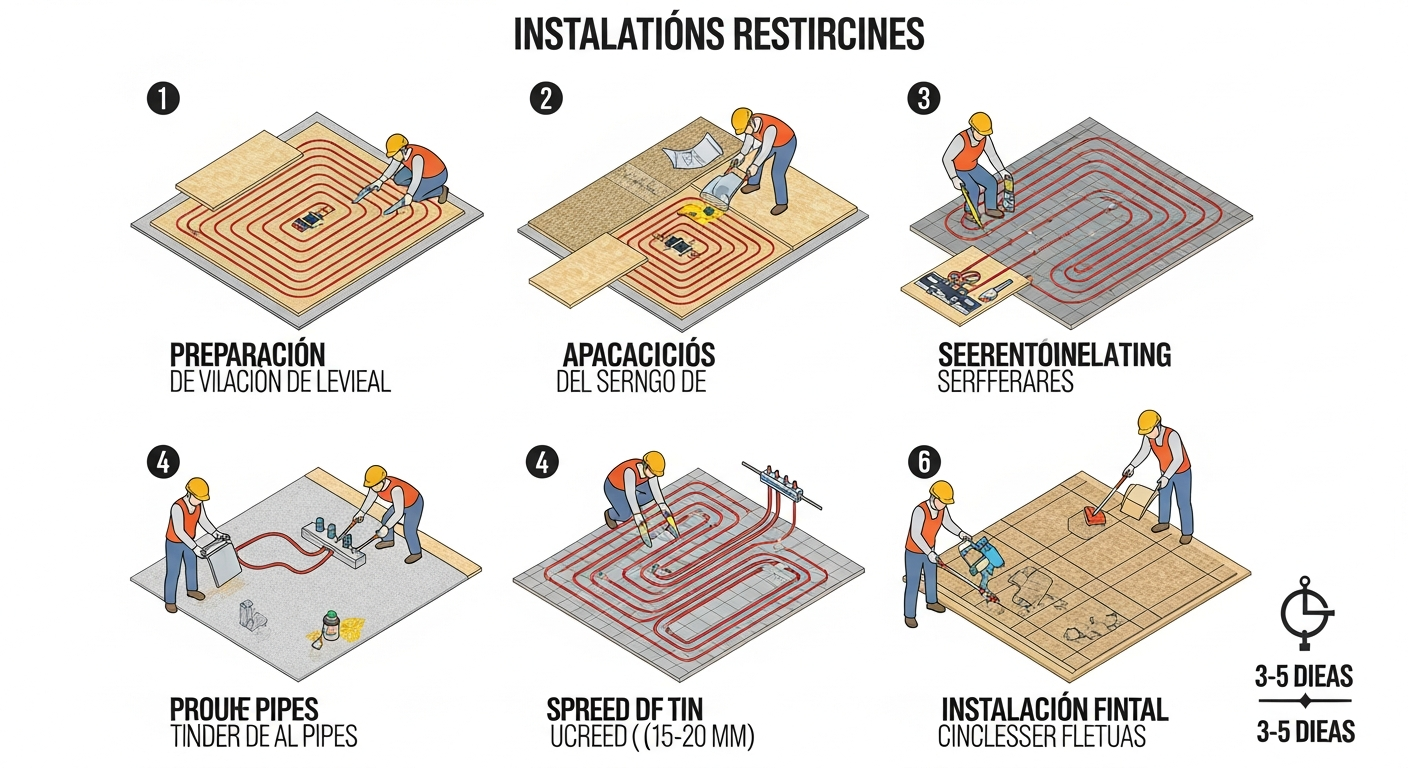
Wet system timeline: 1 week demolition/prep, 3-5 days pipe installation, 3 days screed cure, 2-3 days tile installation, 2 days commissioning = 3-4 weeks minimum. Dry system: 3 days prep, 4-6 days board installation, 2 days commissioning = 10-14 days total. If you're coordinating with other renovation work or have fixed move-in date, dry system offers flexibility. However, don't rush quality - poor installation haunts you for 20+ years.
Are you removing existing radiators/convectors?
FULL UFH SYSTEM - decommission old heating completely
HYBRID SYSTEM - keep radiators upstairs or as backup
Explanation:
Many retrofits keep existing upstairs radiators: lower cost (don't retrofit upstairs), bedrooms heat quickly when needed, backup if UFH fails. The Mijas case study saved €4,200 keeping upstairs radiators. However, if radiators are old, ugly, or you want full radiant comfort everywhere, remove them entirely. Removing radiators frees wall space (furniture placement), eliminates dust circulation, and provides consistent comfort. Single heat pump can serve both UFH and radiators on separate zones if hybrid approach chosen.
Are you selling the property within 5 years?
Consider ROI - UFH adds €8,000-€15,000 property value
Long-term comfort investment - choose optimal system
Explanation:
UFH typically adds €8,000-€15,000 to property sale price (more in luxury market). If you're selling soon, installation cost of €14,500 means €0-€500 net loss BUT property sells 40% faster - buyers love UFH. Energy certificate improves from E to B (major selling point in Spain). If staying 10+ years, focus on comfort and running cost savings (€800-€1,500/year) rather than resale value. The Marbella Golden Mile case study shows property value increased more than retrofit cost.
10 Costly Retrofit Mistakes and How to Avoid Them
Each mistake costs €2,000-€15,000. Learn from others' failures to avoid wasting your investment.
Skipping insulation upgrade before UFH installation
Installing underfloor heating in poorly insulated pre-1990 buildings without first upgrading building envelope. Single glazing, uninsulated walls, and no roof insulation cause massive heat loss that even UFH cannot overcome efficiently.
Consequences:
- • Heat pump runs at high temperatures (45-50°C) killing efficiency
- • COP drops from potential 4.5 to actual 2.1
- • Running costs €250-€400/month instead of €80-€120/month
- • Floors never reach comfortable temperature
- • Payback period extends from 6 years to 15+ years
- • IDAE subsidy may be rejected due to poor building energy rating
How to Prevent:
- ✓ Conduct heat loss assessment BEFORE designing UFH system
- ✓ Upgrade to double glazing (€3,000-€8,000)
- ✓ Install wall insulation if possible (€4,000-€12,000)
- ✓ Add roof insulation (€2,500-€6,000)
- ✓ Target building U-value <0.5 W/m²K before UFH
- ✓ Verify energy certificate will be C or better post-installation
- ✓ The Coín cortijo case study is a WARNING - learn from this €15,000 mistake
Choosing wet system for low-ceiling property
Installing wet underfloor heating (65mm floor raise) in apartments with already-low 2.3-2.4m ceilings, creating oppressive 2.235m final ceiling height and requiring expensive door modifications.
Consequences:
- • Ceiling height feels oppressive - resale value decreases
- • All doors must be shortened (€150-€250 per door × 8 doors = €1,200-€2,000)
- • Built-in wardrobes may no longer close properly
- • May not meet building code minimum ceiling heights (2.5m in some areas)
- • Kitchen base units may need raising (€800-€1,500)
- • Staircase bottom step becomes too short (trip hazard)
How to Prevent:
- ✓ Measure ceiling heights accurately before system selection
- ✓ If ceilings <2.5m, specify DRY SYSTEM ONLY in quotes
- ✓ Dry system adds only 18-35mm vs 65mm for wet
- ✓ Ask installer to show cross-section drawing with final heights
- ✓ Consider ultra-low profile dry systems (12-14mm) for extreme cases
- ✓ The Fuengirola apartment case study avoided this issue with dry system
No heat pump integration planning - missed subsidies
Installing underfloor heating without coordinating heat pump installation, missing out on €3,000-€4,000 in additional IDAE subsidies and paying twice for installation labor.
Consequences:
- • UFH-only subsidy: €2,000-€2,500
- • Combined UFH + heat pump subsidy: €6,000-€7,000
- • Missed subsidy: €3,500-€4,500 lost
- • Separate installations cost €1,500-€2,500 more in labor
- • May need to modify UFH manifold later for heat pump (€800)
- • Old boiler continues using expensive gas/oil during UFH install
How to Prevent:
- ✓ Always get quotes for UFH + heat pump COMBINED
- ✓ Check IDAE subsidy calculator for combined system benefits
- ✓ Even if current heating works, consider replacing for subsidy
- ✓ Coordinate installations: heat pump outdoor unit, indoor manifold, UFH all together
- ✓ Verify installer is F-Gas certified for refrigerant work
- ✓ The Marbella villa case study maximized subsidies with combined installation
DIY installation attempts or unlicensed installers
Attempting DIY underfloor heating installation or hiring unlicensed 'cheap' installers to save €2,000-€3,000, resulting in leaks, poor performance, and expensive professional remediation.
Consequences:
- • Pipe leaks require floor excavation (€3,000-€8,000 repair)
- • Incorrect pipe spacing causes hot/cold spots
- • Poor insulation underneath wastes 30% of heat downwards
- • Manifold not balanced - some rooms overheat, others stay cold
- • No pressure testing before screed = undetected leaks
- • IDAE subsidy rejected without certified installer
- • Home insurance may not cover DIY installation damage
How to Prevent:
- ✓ ONLY use licensed installers with UFH-specific experience
- ✓ Verify installer certifications: F-Gas (if heat pump), RITE certificate
- ✓ Ask for 3 local references and visit completed installations
- ✓ Insist on pressure testing (10 bar, 24 hours) before screed poured
- ✓ Get minimum 5-year installation warranty in writing
- ✓ Verify installer carries professional liability insurance (€2M+ coverage)
- ✓ Cheap installer saves €2,500 but costs €10,000 when it goes wrong
Ignoring Mediterranean climate characteristics
Specifying wet system for Mediterranean climate where rapid temperature response is essential for comfort during variable winter weather (8°C mornings, 18°C afternoons).
Consequences:
- • 6-hour warm-up time means cold mornings before comfort achieved
- • System runs continuously trying to 'catch up' to setpoint
- • Overheating in afternoons when exterior warms up
- • Poor comfort despite system functioning correctly
- • Higher energy use from system hunting for setpoint
- • Occupants dissatisfied despite €15,000 investment
How to Prevent:
- ✓ For Mediterranean mild winters: DRY SYSTEM provides 20-minute response
- ✓ Wet systems better for Northern Europe constant heating
- ✓ Install smart controls with weather compensation
- ✓ Consider hybrid: wet system ground floor (thermal mass), dry upstairs (quick response)
- ✓ Zone system by usage: living areas rapid response, bedrooms slower OK
- ✓ The Nueva Andalucía case study chose dry system specifically for climate match
Inadequate manifold location and accessibility
Installing UFH manifold in inaccessible location (sealed in wall, tiny cupboard, attic access) making future maintenance and adjustments impossible without demolition.
Consequences:
- • Cannot access zone valves for balancing system
- • Flow meters not visible to verify operation
- • Bleed valves inaccessible for air purging
- • Future repairs require wall/ceiling demolition
- • Smart thermostat upgrades not feasible
- • Annual maintenance extremely difficult/expensive
How to Prevent:
- ✓ Manifold cabinet must have 600mm × 600mm clear access
- ✓ Locate in utility room, under stairs cupboard, or dedicated manifold box
- ✓ Ensure adequate lighting and workspace around manifold
- ✓ Plan for future smart valve actuator installation
- ✓ Include isolation valves for each zone for maintenance
- ✓ Insist on manifold location approval before installation begins
Wrong pipe spacing for room heat loss
Using standard 150mm pipe spacing throughout without calculating room-specific heat loss, causing inadequate heating in high-loss areas (north-facing, exterior walls, large windows) and overheating in low-loss rooms.
Consequences:
- • Bathrooms and north bedrooms never reach comfortable temperature
- • Living room with patio doors stays cold despite system running
- • South-facing rooms overheat from combined solar gain and UFH
- • System cannot maintain even 18°C in high-loss rooms
- • Occupants run supplemental electric heaters (defeats UFH purpose)
- • May require complete reinstallation with correct spacing
How to Prevent:
- ✓ Insist on room-by-room heat loss calculation (€300-€600 but essential)
- ✓ High-loss rooms: 100mm pipe spacing
- ✓ Medium-loss rooms: 150mm spacing
- ✓ Low-loss rooms: 200mm spacing
- ✓ External walls may need 75-100mm spacing within 1m of wall
- ✓ Verify installer provides heat output calculations per room
- ✓ Don't accept 'standard installation' - every room is different
No underfloor insulation in ground floor installation
Skipping insulation layer under UFH pipes to save €500-€800, causing 25-40% of heat to be lost downwards into ground or garage below instead of heating the living space.
Consequences:
- • 30-40% of heat wasted into ground (earth temperature 15°C)
- • Floor temperatures 3-5°C lower than designed
- • Heat pump runs longer to compensate for losses
- • Running costs increase by €350-€600/year permanently
- • Never achieves comfortable floor temperature
- • COP reduced from 4.5 to 3.2 due to higher flow temperatures needed
- • Above garage: heating the garage instead of your floor
How to Prevent:
- ✓ ALWAYS install minimum 30mm XPS insulation under UFH pipes
- ✓ Ground floors: 50mm XPS or EPS insulation minimum
- ✓ Above unheated spaces (garage, crawlspace): 80-100mm insulation
- ✓ Edge insulation around perimeter to prevent lateral heat loss
- ✓ Insulation costs €8-€15/m² but saves €30-€50/m²/year in energy
- ✓ Verify insulation specification in written quote - non-negotiable
- ✓ This €600 saving costs you €12,000 over system lifetime
Coastal installation without corrosion protection
Installing standard manifolds, fittings, and heat pumps in coastal locations (<1km from sea) without specifying salt-resistant materials and coatings, leading to premature failure in 4-7 years instead of 20+ year expected life.
Consequences:
- • Manifold brass fittings corrode and fail (4-6 years vs 20+ inland)
- • Heat pump outdoor coil corrodes rapidly
- • Electrical connections oxidize causing failures
- • Zone valve actuators seize from salt intrusion
- • Average coastal heat pump life: 6 years vs 15 years inland
- • Complete system replacement needed instead of 20+ year life
How to Prevent:
- ✓ Specify STAINLESS STEEL manifolds for coastal installations
- ✓ Heat pump must have factory coastal corrosion protection coating
- ✓ Annual heat pump coil washing (€120/year prevents €10,000 replacement)
- ✓ Dielectric grease on all outdoor electrical connections
- ✓ Extended warranty: 7 years for coastal-spec equipment
- ✓ The Torremolinos case study shows proper coastal specification
- ✓ Extra €1,500 for coastal protection saves €10,000 in premature replacement
Installing UFH without addressing existing damp problems
Covering existing ground floor damp issues with new UFH system, trapping moisture under new floor and causing mold, odors, and system degradation. Damp must be resolved BEFORE UFH installation.
Consequences:
- • Moisture trapped under UFH causes mold growth
- • Musty odors throughout home from under-floor mold
- • Insulation becomes waterlogged and ineffective
- • Wood flooring warps or rots in dry system installations
- • Tile adhesion fails causing hollow tiles and cracks
- • Health impacts from mold spores
- • Must excavate entire UFH to address damp properly
How to Prevent:
- ✓ Conduct damp survey BEFORE UFH installation (€200-€400)
- ✓ Resolve rising damp with proper damp proof course
- ✓ Install damp proof membrane under all ground floor UFH
- ✓ Fix water ingress sources (drainage, groundwater)
- ✓ Allow 4-6 weeks after damp treatment before UFH installation
- ✓ Verify moisture levels <75% RH before proceeding
- ✓ Damp treatment costs €2,000-€5,000 but prevents €12,000 reinstallation
IDAE Subsidies 2025: Complete Application Guide
Agua Therm does not process subsidies — we are installers
IDAE grant applications, IRPF tax deductions, and IBI/ICIO rebates must be processed by you or an independent specialist subsidy company. Agua Therm will provide all the installation documentation you need (invoices, installation certificate, technical specs) for your application.
See our list of verified specialist companiesUnlock €6,000-€7,000 in Spanish government subsidies for your underfloor heating + heat pump retrofit

2025 Subsidy Amounts
Typical 100m² retrofit: €2,500
8-12kW heat pump: €3,500
OPTIMAL strategy!
Step-by-Step Application Process
Pre-assessment
Get current energy certificate (before work). Cost: €150-€300.
Select Installer
Get 3+ quotes from certified installers. Verify IDAE registration, RITE certificate, liability insurance.
Submit Application BEFORE Installation
CRITICAL: Application must be submitted BEFORE work begins or will be rejected.
Wait for Approval
Processing time: 2-4 months. Do not start work until approval received.
Professional Installation
Installer completes work with all documentation. Keep all invoices.
Post-Installation Certificate
Get new energy certificate showing improvement. Must improve at least 2 rating levels.
Submit Final Documentation
Submit: invoices, energy certificates, technical specs, proof of payment.
Receive Payment
Subsidy payment 3-6 months post-installation via bank transfer.
WARNING: Common Rejection Reasons
- • Work started BEFORE submitting application
- • Insufficient energy certificate improvement (<2 levels)
- • Installer not RITE certified
- • Incomplete documentation
- • Second home (only primary residences eligible)
Heat Pump Integration: COP Optimization
Achieve COP 4.5-4.8 efficiency with correct flow temperatures for Mediterranean climate
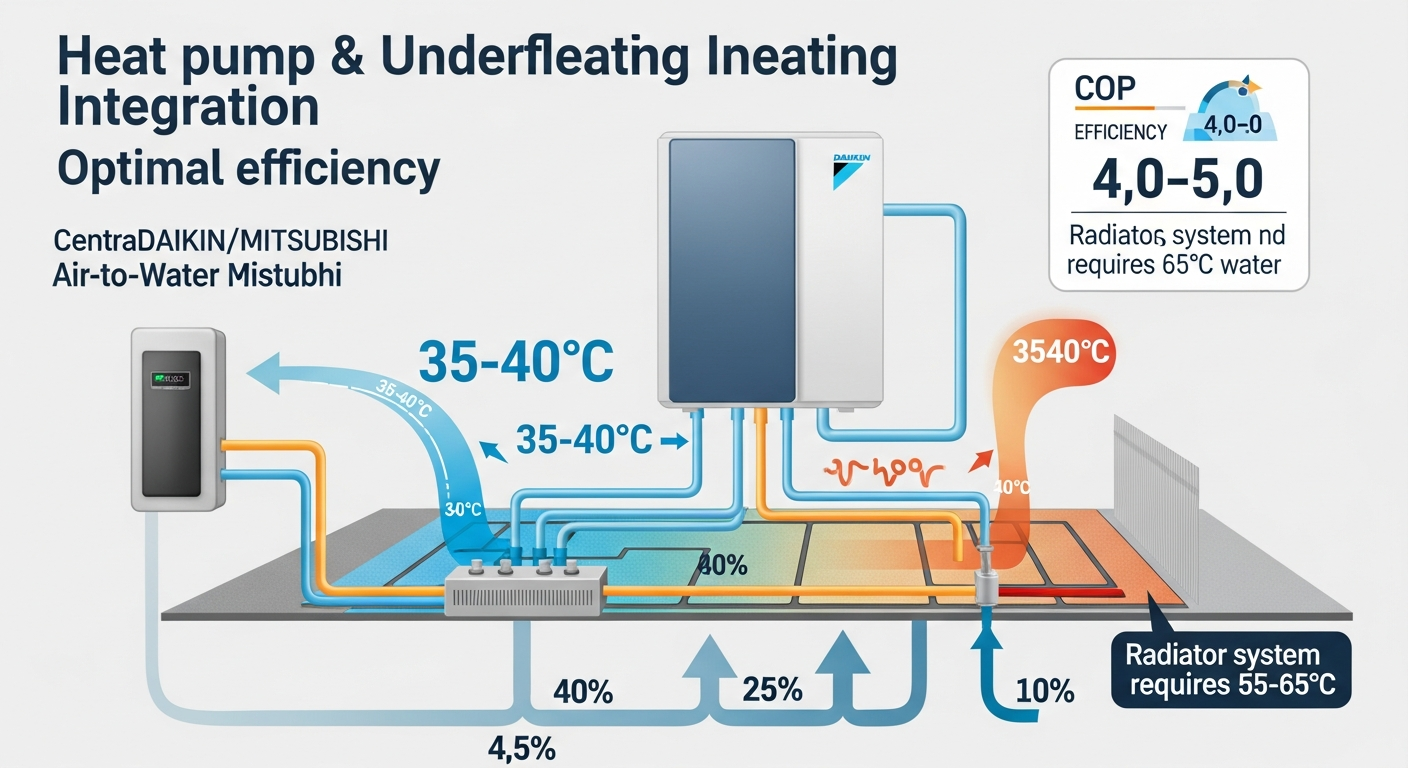
CORRECT Setup ✓
Optimal COP 4.5-4.8 in Mediterranean climate
Allows sufficient heat output at low flow temp
U-value <0.5 W/m²K reduces heat demand
Adjusts flow temp based on outdoor
INCORRECT Setup ✗
Terrible COP 2.0-2.5 wastes electricity
Insufficient heat output forces high temp
U-value >1.5 W/m²K massive heat loss
Runs at fixed temp wasting energy
Coín Case Study Lesson
What went wrong:
- 1970s cortijo without insulation upgrade
- Heat pump forced to run at 45-50°C
- COP achieved: only 2.1 (should be 4.5+)
- Running cost: €320/month vs €180 old system
- €15,000 wasted
Should have done:
- Spend €8,000 on insulation FIRST
- Then install smaller UFH system
- Heat pump would run at 30-35°C
- COP achieved: 4.5 (2x better efficiency)
- Cost: €18,000 total but WORKS
Mediterranean Climate Considerations
Why dry systems work better for Costa del Sol's variable winter climate
Costa del Sol Climate
Typical Winter Day:
Heating Season:
- • December-February: Regular heating needed
- • November + March: Intermittent heating
- • April-October: No heating in most properties
Why Dry System Wins
20 minutes cold to comfortable vs 4-6 hours for wet system
Turn on only when cold. Wet system must run 24/7 for comfort
Heat only rooms in use. Wet system less effective for zoning
Turn off when afternoon sun arrives. Low thermal inertia ideal
Heating Pattern Comparison
Dry System - Mediterranean Ideal
Wet System - Poor for Mediterranean
Availability in Málaga Province
Agua Therm installs wet and dry underfloor heating systems across all Málaga province
Major Municipalities
Interior and Mountain
Complete Service Across All Municipalities
IDAE Documentation
Complete installation documentation for your subsidy applications
Certified Installers
RITE certified, 10+ years experience
5-Year Warranty
Complete installation and labor warranty
Frequently Asked Questions
Detailed answers to common questions about underfloor heating retrofits in Spain
About the Author

Ben Hayden
English-Speaking Electrician & Independent Energy Advisor
Ben Hayden is an English speaking electrician and independent energy advisor based in Marbella, Spain, with over 15 years of electrical experience across Europe. He provides independent energy and electrical checks for overseas property owners and managers across the Costa del Sol — helping clients cut electricity bills, navigate Spanish regulations, and make confident decisions on solar PV, heat pump, EV charger and battery storage projects.
Ben advises in plain English on projects where the paperwork is in Spanish and the stakes are high. His writing has appeared in ExpatArrivals, The Olive Press, Euro Weekly News, BuildingTalk and pv magazine.