

Equipment installed on this project

'%20id='layer1'%3e%3cg%20transform='matrix(1.812145,0,0,-1.812145,462.23619,762.77017)'%20id='g53028'%3e%3cpath%20id='path53030'%20style='fill:currentColor;fill-opacity:1;fill-rule:nonzero;stroke:none'%20d='m%200,0%20-37.453,0%200,-34.554%20L%200,0'%20/%3e%3c/g%3e%3cg%20transform='matrix(1.812145,0,0,-1.812145,428.29471,762.77017)'%20id='g53032'%3e%3cpath%20id='path53034'%20style='fill:currentColor;fill-opacity:1;fill-rule:nonzero;stroke:none'%20d='m%200,0%20-18.724,0%200,-17.285%20L%200,0'%20/%3e%3c/g%3e%3cg%20transform='matrix(1.812145,0,0,-1.812145,557.00956,776.36126)'%20id='g53036'%3e%3cpath%20id='path53038'%20style='fill:currentColor;fill-opacity:1;fill-rule:nonzero;stroke:none'%20d='m%200,0%20-4.889,-19.547%208.638,0%20L%208.634,0%200,0'%20/%3e%3c/g%3e%3cg%20transform='matrix(1.812145,0,0,-1.812145,521.25957,796.89105)'%20id='g53040'%3e%3cpath%20id='path53042'%20style='fill:currentColor;fill-opacity:1;fill-rule:nonzero;stroke:none'%20d='M%200,0%20-1.981,0%201.213,5.639%202.249,0%200,0%20Z%20m%20-1.229,11.331%20-11.109,-19.546%205.713,0%201.844,3.258%207.931,0%200.591,-3.258%208.432,0%20-3.584,19.546%20-9.818,0'%20/%3e%3c/g%3e%3cg%20transform='matrix(1.812145,0,0,-1.812145,628.49506,776.36126)'%20id='g53044'%3e%3cpath%20id='path53046'%20style='fill:currentColor;fill-opacity:1;fill-rule:nonzero;stroke:none'%20d='m%200,0%20-4.876,-19.547%208.636,0%20L%208.637,0%200,0'%20/%3e%3c/g%3e%3cg%20transform='matrix(1.812145,0,0,-1.812145,621.50018,776.36126)'%20id='g53048'%3e%3cpath%20id='path53050'%20style='fill:currentColor;fill-opacity:1;fill-rule:nonzero;stroke:none'%20d='m%200,0%20-8.851,0%20-7.409,-6.394%201.617,6.394%20-8.279,0%20-4.876,-19.547%208.253,0%201.686,6.748%204.413,-6.748%209.99,0%20L%20-10.855,-9.31%200,0'%20/%3e%3c/g%3e%3cg%20transform='matrix(1.812145,0,0,-1.812145,486.6186,792.45854)'%20id='g53052'%3e%3cpath%20id='path53054'%20style='fill:currentColor;fill-opacity:1;fill-rule:nonzero;stroke:none'%20d='m%200,0%20c%200,0%20-0.561,-6.349%20-5.971,-6.349%20l%20-3.061,0%202.696,10.543%202.778,0%20C%20-2.564,4.188%200.313,3.93%200,0%20Z%20m%20-0.438,8.874%20-2.234,0.007%20-10.808,0%20-4.876,-19.539%2010.732,0%204.246,-0.006%20c%205.978,0%2011.861,4.45%2011.861,11.266%200,8.02%20-8.921,8.272%20-8.921,8.272'%20/%3e%3c/g%3e%3cg%20transform='matrix(1.812145,0,0,-1.812145,681.52929,776.35582)'%20id='g53056'%3e%3cpath%20id='path53058'%20style='fill:currentColor;fill-opacity:1;fill-rule:nonzero;stroke:none'%20d='M%200,0%20-2.881,-11.51%20-6.719,0%20l%20-9.606,0%20-4.88,-19.55%205.973,0%202.909,11.611%203.85,-11.611%209.565,0%20L%205.979,0%200,0'%20/%3e%3c/g%3e%3c/g%3e%3c/svg%3e)
Mijas Villa: Airzone Flexa 4.0 — 4-Zone Underfloor Heating Control
How Agua Therm installed Spain's most advanced hydronic zoning system to give a Mijas homeowner independent room-by-room comfort — connected to a Daikin mini chiller, controlled from any smartphone.
Location
Mijas, Costa del Sol
System
Airzone Flexa 4.0
Heat Source
Daikin Mini Chiller
Zones
4 Independent
Completed
July 2025
Control
Airzone Cloud App
The Problem: A Villa Without Zone Control
The client, a homeowner in Mijas on the Costa del Sol, had a perfectly functional Daikin mini chiller feeding their underfloor heating. The problem was control — or the complete absence of it. Without a zoning system, the entire villa heated or cooled as a single block. The living room, master bedroom, guest rooms, and bathrooms all called for water simultaneously. Rooms that reached temperature had no way to shut off their floor circuit. The chiller ran constantly, conditioning rooms that needed nothing, while the homeowner had no way to set different temperatures for different areas — or to turn off rooms they weren't using.
Issues identified before installation
- ✕Entire villa heated as a single zone — no room-by-room temperature control possible
- ✕Guest bedrooms heated overnight even when unoccupied
- ✕No scheduling — system had to be manually controlled via the chiller's basic thermostat
- ✕No smart home integration — no app, no voice control, no remote access
- ✕Floor overheating risk — no floor probe logic to prevent surface temperature exceeding safe limits
- ✕Daikin chiller unable to modulate output — ran at full capacity regardless of actual demand
The Solution: Airzone Flexa 4.0 Hydronic Zoning
Agua Therm specified and installed a complete Airzone Flexa 4.0 hydronic zoning system, integrating the existing Daikin mini chiller with a 4-zone independent temperature control network. Each room now has its own Airzone thermostat, its own motorized zone valve actuator on the UFH manifold, and its own temperature schedule. The Daikin chiller modulates its output based on actual demand from all active zones — when all zones reach their target temperature, the chiller receives a stop signal. When demand rises, it modulates back up proportionally.
Every Component in the Photo — Identified and Explained
The photograph shows the complete Airzone Flexa 4.0 installation kit laid out before installation at the Mijas villa — seven distinct component types, each with a specific role in the system. Here is a precise breakdown of every item visible:
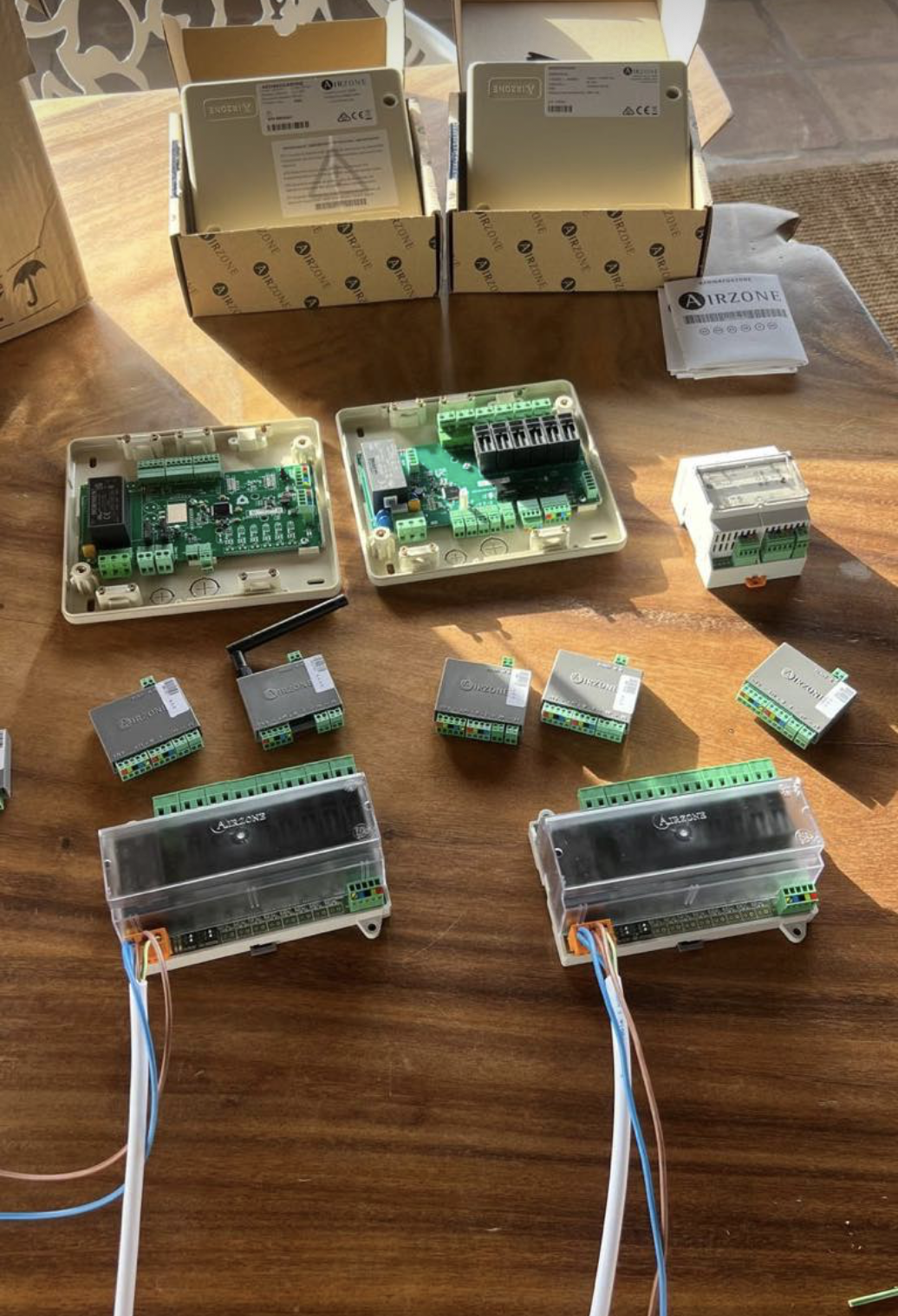
Airzone Thermostats in Retail Packaging (top of photo, 3 boxes)
The three Airzone-branded cardboard boxes at the top of the photo contain room thermostats — one for each of the four zones (a fourth box is just off-frame). These are either Airzone Blueface or Airzone Think thermostats, chosen based on the zone's role. The master zone (typically the living room) receives a Blueface — the flagship Airzone thermostat with a full-colour capacitive touchscreen, room temperature and humidity sensing, mode selection (heating/cooling/fan/auto), and fan speed control. Satellite zones use the Think thermostat — a wall-mounted unit with an e-ink display and touch buttons that measures room temperature and humidity and allows setpoint adjustment within configurable limits set by the installer. Each thermostat connects to the RS-485 Modbus bus with a standard Airzone 4-wire cable (2 power + 2 data) and requires no external power supply — it draws power from the control board.
Why not alternatives? The Blueface Zero was considered for the master zone but rejected — the full Blueface provides humidity monitoring (useful in coastal Mijas microclimates) and gives the homeowner full system control without needing the app. The Lite thermostat (basic LED + capacitive buttons) was ruled out for all zones — it only allows ±3°C adjustment from a fixed base setpoint, which is too restrictive for a villa where different family members want different room temperatures.
Airzone Flexa 4.0 Main Control Boards (2x white plastic enclosures with green PCBs)
The two white plastic surface-mount enclosures with green printed circuit boards are the brains of the Airzone Flexa 4.0 system. These are the Airzone central control boards — the AZCE8 series (8-zone capacity) — which orchestrate all communication between thermostats, zone valve actuators, and the Daikin chiller gateway. Each board features: an RS-485 Modbus master interface for the thermostat bus; relay outputs for zone valve actuator control (24V); a configurable relay output for high/low temperature circuit demand; and an integration bus port for the Daikin communication gateway. The green PCB visible inside each enclosure shows the relay bank, terminal blocks (green screw terminals), and the main microprocessor. Two boards are present in this installation — one per UFH circuit (typically ground floor and first floor, each with their own manifold and zone valve arrangement).
Why not alternatives? A single control board can manage up to 8 zones. With only 4 zones in this villa, one board would technically suffice. Two boards were specified because the villa has two separate UFH manifolds on different floors — architecturally it is cleaner and electrically safer to keep each floor's control circuitry separate, with each board managing its own floor's zones, actuators, and manifold pressure.
DIN Rail Mounted Module (top right, red/orange indicator)
The DIN rail-mounted module with the red indicator visible at the top right of the photo is the Airzone system power supply — a 24V DC DIN rail power supply unit that provides regulated low-voltage power to the zone valve actuators and communication modules. DIN rail mounting is the European standard for panel-mounted electrical components — the slim, symmetrical profile allows multiple modules to clip side-by-side on a standard 35mm DIN rail inside a distribution panel. The red/orange indicator confirms the unit is receiving mains input power. This power supply is separate from the control board's logic supply: the board manages data and signals at low current, while the PSU handles the higher-current 24V demand from multiple simultaneously-open zone valve actuators.
Airzone Webserver / Cloud HUB (grey module with WiFi antenna)
The grey Airzone module with the upright WiFi antenna is the Airzone Webserver — the system's connectivity and smart home integration hub. Once connected to the villa's WiFi network, the Webserver provides: (1) Full remote control via the Airzone Cloud app (iOS and Android) — the homeowner can adjust any zone's temperature, set schedules, switch between heating and cooling mode, and monitor system status from anywhere in the world; (2) Integration with Amazon Alexa and Google Assistant for voice control; (3) Local REST API for integration with home automation platforms including Control4, Crestron, Lutron, KNX, and Home Assistant; (4) BACnet and Modbus TCP/IP protocols for building management system (BMS) integration. The antenna optimises WiFi signal in areas where the router signal is weak — common in Spanish villas with thick stone walls.
Why not alternatives? Some installers omit the Webserver to reduce cost. This is a false economy for any villa where the owner may not always be present — remote temperature monitoring and schedule management are genuinely useful. The Webserver costs a fraction of the total system cost and adds substantial long-term value through remote management capability.
Zone Modules — BUS Zone Controllers (4–5 small grey modules with green terminal blocks)
The cluster of small grey modules with bright green screw terminal blocks in the centre of the photo are the Airzone BUS zone modules — one per zone, four in this installation. Each zone module is a dedicated microcontroller that manages the interface between its zone's thermostat data (received via the RS-485 bus from the control board) and its zone's physical hardware outputs: the 24V signal to the motorized zone valve actuator on the manifold, and optionally the floor probe temperature input. The green terminal blocks provide the connection points for: the RS-485 Modbus bus in/out (daisy-chained through all modules), the 24V actuator output cable, and the floor probe input (2-wire NTC sensor). Each zone module reports its zone's status to the control board every cycle — valve open/closed, floor probe temperature (if fitted), thermostat setpoint received.
Zone Valve Wiring Centres (2x large black/clear-lid modules with cables)
The two larger modules at the bottom of the photo — black enclosures with transparent lids and multi-core cables already connected — are the zone valve actuator wiring centres. These are junction boxes where the 24V control cables from the Airzone zone modules terminate and distribute to the individual motorized zone valve actuators on each UFH manifold. Each wiring centre serves one floor's manifold — the blue and white cables entering the bottom of each unit are the 24V actuator cables routed through the villa's walls and floor voids to reach the manifold location (typically in a services cupboard or utility area). The transparent lid allows visual inspection of the terminal connections without opening the enclosure — an important maintenance feature in an active installation. The cables are already terminated in these units in the photo, indicating the actuator runs to the manifold were pre-wired before the main system components arrived.
How Airzone Flexa 4.0 Works: A Technical Explanation
Airzone Flexa 4.0 is a hydronic climate control system — purpose-built for water-based heating and cooling circuits including underfloor heating (UFH), hydronic radiators, and fan coil units. Understanding how it works requires understanding three separate communication layers that operate simultaneously:
Layer 1: Zone Thermostat → Control Board (RS-485 Modbus Bus)
Each room's Airzone thermostat (Blueface or Think model) continuously measures room temperature and compares it against the user's setpoint. All thermostats connect to the Airzone Flexa main control board via a shared RS-485 Modbus communication cable — a two-wire bus that daisy-chains from thermostat to thermostat throughout the property. The RS-485 standard was chosen because it is highly resistant to electrical interference, works reliably over cable runs of up to 1,200 metres, and supports multiple devices (up to 32) on a single cable pair. Each thermostat has a unique address on the bus (Zone 1, Zone 2, etc.), allowing the control board to poll each one independently every few seconds.
Layer 2: Control Board → Zone Valve Actuators (24V Output)
When a zone thermostat reports that the room is below setpoint, the Flexa 4.0 control board sends a 24V activation signal to the motorized zone valve actuator for that zone on the UFH manifold. The actuator — a small electrothermal or motorized device fitted to the valve body — opens the valve, allowing heated or chilled water from the Daikin chiller to flow through the floor circuit for that room. When the thermostat reports that the target temperature has been reached, the 24V signal is removed, the actuator spring-returns to the closed position, and water flow to that zone stops. Airzone Flexa 4.0 supports up to 20 wired zone valve actuators and 10 wireless actuators — far more than this 4-zone installation requires, leaving substantial room for future expansion.
Layer 3: Control Board → Daikin Mini Chiller (Communication Gateway)
The most technically sophisticated element of the installation is the integration between the Airzone Flexa control board and the Daikin mini chiller. Rather than a simple on/off signal, Airzone uses a dedicated Daikin communication gateway (the Aidoo Pro protocol bridge) that speaks Daikin's proprietary P1P2 or Open Therm bus language. This two-way communication means: when all four zones have reached setpoint and all valve actuators are closed, the Flexa board sends a stop command to the chiller — it ceases operation completely. When zones start calling for heating again, the Flexa board sends a modulated demand signal, allowing the Daikin inverter compressor to ramp up gradually rather than starting at full power. The result is that the chiller only works as hard as the system needs — no more constant-speed operation.
eu.bac Certified Accuracy
Airzone Flexa 4.0 is certified by the European Building Automation and Controls Association (eu.bac) with a temperature control accuracy of ±0.4°C for underfloor heating applications. For context, most standalone UFH thermostats have accuracy of ±1–2°C — Airzone's precision is five times tighter.
Floor Protection
A critical feature specific to UFH applications is Airzone's floor probe integration. Each zone can have a floor temperature sensor embedded in the screed or slab. The Flexa 4.0 board continuously monitors floor surface temperature and enforces a configurable maximum (typically 26–28°C for timber floor coverings, 29°C for tile). This prevents floor damage from overheating — a real risk when a zone is unoccupied for extended periods and the setpoint takes a long time to reach.
Why Airzone Flexa 4.0 — Not the Alternatives
Agua Therm's team assessed the full Airzone product range before specifying Flexa 4.0 for this Mijas installation. This section explains every option considered and why each was accepted or rejected — demonstrating the depth of product knowledge required to make the right specification decision:
The Aidoo Pro is a smart gateway for a single AC unit — it connects to one indoor unit (split, cassette, or similar) and provides WiFi control, scheduling, and home automation integration for that unit only. It does not provide multi-zone control. It has no zone valve actuator outputs, no RS-485 thermostat bus, and no ability to create independent room-by-room temperature control. For a single mini-split in a bedroom, Aidoo Pro is excellent — for a multi-zone UFH system, it is the wrong product entirely.
Flexa 3.0 is the previous generation of the Flexa system, designed primarily for ducted air conditioning systems. Critically, Flexa 3.0 uses pneumatic or electric damper control outputs designed for ductwork motorised dampers — not the 24V zone valve actuator outputs required for hydronic UFH systems. While Flexa 3.0 can be adapted for some hydronic applications with additional hardware, it lacks the native floor probe integration, the hydronic-specific control algorithms (thermal inertia compensation, anti-overheating logic), and the eu.bac certification for UFH precision that Flexa 4.0 provides as standard.
Flexa 25 Plus is Airzone's most advanced system, adding an integrated air quality sensor (CO₂, TVOC, particulates), ionization air purification, and controlled mechanical ventilation (CMV/HRV) integration. For this Mijas UFH installation, none of these additional features were required — the system is purely hydronic with no ductwork. Specifying Flexa 25 Plus would have added significant cost for features that cannot be used with underfloor heating. Flexa 4.0 provides everything this installation requires at the correct price point.
Easyzone is the North American market version of the Airzone zoning system — designed for flexible ductwork and the US/Canadian HVAC market. It uses different physical specifications, different communication protocols, and is not officially sold or supported in Spain/EU. Easyzone is sometimes confused with Flexa because the underlying technology is similar, but it is an entirely separate product family. Any installer specifying Easyzone for a European hydronic installation either does not understand the product range or is working from US market documentation.
A KNX building management system could theoretically achieve similar zone valve control. However, KNX requires separate KNX-certified thermostats, KNX actuators, a KNX programming environment (ETS), and a certified KNX programmer — all of which add substantial cost and ongoing maintenance complexity. KNX also has no native Daikin protocol integration, requiring additional interface modules. Airzone Flexa 4.0 provides equivalent or superior functionality at a fraction of the cost, with a single integrated system and native Daikin gateway support.
Honeywell's Evohome system provides multi-zone hydronic control and is widely installed across Europe. However, it lacks native Daikin mini chiller protocol integration — it uses a generic on/off demand output that cannot modulate the inverter chiller's compressor speed. It also has no Modbus/BACnet integration for smart home platforms. Control accuracy is ±0.5°C vs Airzone's certified ±0.4°C. Airzone Flexa 4.0 was specified over Honeywell on technical merit.
Daikin Mini Chiller Integration: How It Works
The Daikin mini chiller (EWAQ series) is a compact, inverter-controlled air-to-water chiller for residential applications. Unlike a conventional split-system heat pump, a chiller produces heated or chilled water which is then circulated via hydronic pipework to the underfloor heating circuits — it is a fundamentally different machine to a standard air-to-air heat pump. Integrating the Airzone Flexa 4.0 system with the Daikin chiller required the Airzone Daikin communication gateway, which handles bidirectional protocol translation.
Zone Demand Aggregation
The Airzone Flexa control board continuously evaluates which zones are calling for heating. When at least one zone's thermostat reports a temperature below setpoint, the board generates a heating demand signal. The strength of this demand — communicated to the Daikin chiller via the gateway — is proportional to the number of zones calling and the temperature differential in each zone. With all four zones at maximum setpoint deficit (e.g., cold morning start-up), the chiller receives maximum demand and its inverter compressor ramps to full capacity. As zones reach temperature and their valve actuators close, demand reduces and the compressor modulates down.
Anti-Short-Cycle Protection
Inverter heat pumps and chillers are damaged by rapid start-stop cycling — each start puts thermal stress on the compressor. The Airzone Flexa 4.0 system incorporates anti-short-cycle logic: once the Daikin chiller is stopped (all zones satisfied), the system enforces a minimum off-time (configurable, typically 3–5 minutes) before it can be restarted. UFH's high thermal mass works in the system's favour here — floor screed stores heat effectively, meaning that once a zone's floor is up to temperature, it continues to warm the room for an extended period even after the valve closes, delaying the next call for heat.
Flow Temperature Control
Airzone Flexa 4.0 includes weather-dependent flow temperature control (weather compensation) — it can adjust the Daikin chiller's target flow temperature based on outdoor ambient temperature, communicated via an outdoor sensor. On a mild Mijas morning of 15°C, the chiller might target a flow temperature of 32°C. On a cold Mijas January night of 5°C, it might target 40°C. This maintains comfort while ensuring the chiller always operates at the lowest necessary flow temperature — inverter chillers are significantly more efficient at lower flow temperatures.
Two-Way Error Reporting
The Airzone-Daikin gateway is bidirectional: the Daikin chiller's fault codes and operational data are passed back to the Airzone Flexa control board and displayed on the master Blueface thermostat and in the Airzone Cloud app. A refrigerant pressure fault, a flow sensor alarm, or a communication error on the chiller will trigger an alert visible on the Airzone interface — without the gateway, these faults would only be visible by physically inspecting the chiller's own control panel.
The Installation: From Components to Commissioned System
The Mijas villa installation was completed over two days in July 2025. The physical installation work and commissioning process follows a specific sequence to ensure all components are correctly integrated before the system is handed over:
- Assessment of existing UFH manifold — verify zone valve locations, pipe labelling, and flow balancing settings
- Installation of motorized zone valve actuators on each manifold port (4 actuators — one per zone), replacing the manual ball valves previously fitted
- Cable routing — 4-core Airzone-specification cable (2 power + 2 data) from each zone's thermostat location back to the plant room distribution point
- RS-485 Modbus bus daisy-chain wiring — thermostats connected in sequence with correct termination resistors at the first and last device on the bus
- 24V actuator cables routed from plant room to manifold location, terminated in actuator wiring centres
- Mounting and wiring of Flexa 4.0 control boards, DIN rail power supply, zone modules, and Webserver in the electrical panel or dedicated Airzone enclosure
- Power-up sequence: control boards, then power supply, then peripheral modules — verifying no wiring faults before connecting thermostats
- RS-485 bus address assignment — each thermostat allocated its unique zone address (1–4) via the control board configuration interface
- Actuator function test — each zone valve actuator commanded open and closed individually, flow verified at manifold sight glass
- Daikin gateway configuration — Aidoo Pro gateway connected to Daikin P1P2 bus, protocol parameters set, bidirectional communication confirmed
- Full system heating test — all zones called simultaneously, chiller response verified, flow and return temperatures measured at manifold
- Airzone Cloud setup — Webserver connected to villa WiFi, Airzone Cloud account created, all zones named (Living Room, Master Bedroom, Guest Room 1, Guest Room 2)
- Schedule programming — weekday and weekend temperature schedules set per zone according to homeowner's lifestyle requirements
- Homeowner handover — demonstration of Airzone Cloud app, voice control setup (Google Assistant), and explanation of maintenance schedule
Expert Insights
Rob Greeves — HVAC Director
"The Flexa 4.0 is our go-to specification for any villa with underfloor heating connected to a mini chiller or heat pump — and this Mijas project is a textbook example of why. Before we installed Airzone, the Daikin chiller was running at full tilt regardless of demand. The homeowner had no way to turn off the guest bedrooms when they were empty. In a Mijas villa with its relatively mild winters, this is a significant waste. What Airzone Flexa 4.0 does is create intelligent, proportional demand management: the chiller only runs what the rooms actually need, and it modulates its compressor speed to match. The eu.bac certified ±0.4°C accuracy for UFH means the living room stays at exactly 21°C, not 21.8°C. That level of precision is what separates a proper zoning system from a basic programmable thermostat."

Rob Greeves
HVAC Director, Agua Therm
Craig Whitham — Electrical Director
"The RS-485 Modbus bus is the foundation of the entire Airzone system, and getting it right on day one prevents 80% of the problems we see when we're called to fix other companies' Airzone installations. The bus needs correctly positioned termination resistors — one at each physical end of the cable run — and the cable needs to be routed away from 230V mains wiring to prevent electromagnetic interference. We use shielded twisted-pair cable on all our Airzone installations in coastal villas, because salt air accelerates oxidation on bare copper terminals, and a corroded RS-485 connection is the number one cause of zone communication failures. On this Mijas installation, we also fitted surge protection on the Daikin gateway — Málaga thunderstorms in September and October can send voltage spikes through the P1P2 bus that destroy gateway electronics. A surge protector costs very little and protects equipment worth many times more."

Craig Whitham
Electrical Director, Agua Therm
Installation Results
4
Independent Zones
±0.4°C
Control Accuracy
App + Voice
Smart Control
2 Days
Installation
Inverter
Chiller Modulation
Up to 8
Zones Expandable
Why Airzone? The Case for Spain's Leading Zoning System
Airzone is a Spanish company — headquartered in Málaga, Andalucía (Calle Marie Curie 21, 29590), founded in 2003, and now the largest manufacturer of HVAC zoning systems in southern Europe. This matters for several reasons:
Official website: airzonecontrol.com · Phone: +34 900 400 445
The Complete Airzone Product Range — What Agua Therm Installs
Understanding the full Airzone range allows us to specify precisely the right product for each installation:
| Product | Application | Zones |
|---|---|---|
| Airzone Aidoo Pro | Single AC unit smart control | 1 unit, no zoning |
| Airzone Flexa 3.0 | Ducted AC zoning (multi-zone air) | Up to 8 zones |
| Airzone Flexa 4.0 This install | Hydronic UFH + radiator zoning | Up to 8 zones, 20 wired + 10 wireless actuators |
| Airzone Flexa 25 Plus | Advanced ducted system with IAQ | Up to 8 zones + CMV + IAQ |
| Airzone Easyzone (Americas) | US/Canadian market equivalent of Flexa | Up to 6–8 zones (US specs) |
Frequently Asked Questions — Airzone Flexa 4.0 Underfloor Heating
Manufacturers, Standards & Official Sources
On this installation we work exclusively with internationally recognised manufacturers and in full compliance with current European and Spanish regulation. For full transparency and verification, we link below to the official sources for each manufacturer of equipment or instrumentation used on this project, as well as the applicable legal texts:
Spanish manufacturer of the Flexa 4.0 main control boards, zone modules, Webserver Cloud HUB and Blueface/Think thermostats deployed on this project.
Spanish subsidiary of Daikin Industries — manufacturer of the EWAQ mini chiller integrated via the Aidoo Pro RS-485 Modbus gateway.
European Building Automation Controls Association — issuer of the eu.bac certification confirming the ±0.4°C control accuracy of Airzone Flexa 4.0.
International KNX standard for home and building control — relevant for Airzone integrations with KNX-based BMS systems.
Consolidated text of the European Regulation on fluorinated greenhouse gases — applicable to the Daikin EWAQ chiller refrigerant circuit.
Spanish Royal Decree on marketing and handling of fluorinated gases — required for any technician working on the chiller's refrigerant circuit.
External links open in a new tab. Agua Therm is an independent installer and does not officially represent any of the manufacturers cited — the links are provided solely as verifiable technical reference.
Also see
About the Author

Ben Hayden
English-Speaking Electrician & Independent Energy Advisor
Ben Hayden is an English speaking electrician and independent energy advisor based in Marbella, Spain, with over 15 years of electrical experience across Europe. He provides independent energy and electrical checks for overseas property owners and managers across the Costa del Sol — helping clients cut electricity bills, navigate Spanish regulations, and make confident decisions on solar PV, heat pump, EV charger and battery storage projects.
Ben advises in plain English on projects where the paperwork is in Spanish and the stakes are high. His writing has appeared in ExpatArrivals, The Olive Press, Euro Weekly News, BuildingTalk and pv magazine.
Want Airzone Zoning in Your Mijas Villa?
Agua Therm installs the full Airzone range across the Costa del Sol — from a single Aidoo Pro for a bedroom split-system to a complete 8-zone Flexa 4.0 underfloor heating control system for a luxury villa. Every installation starts with a free site survey and a detailed written quotation.