

HVAC Sizing Guide
Calculate the exact HVAC system size needed for your Costa del Sol property
Editorial context
This guide provides general information, not an independent technical review or property-specific advice. Regulations, prices and product availability change; confirm the details that apply with a qualified professional.
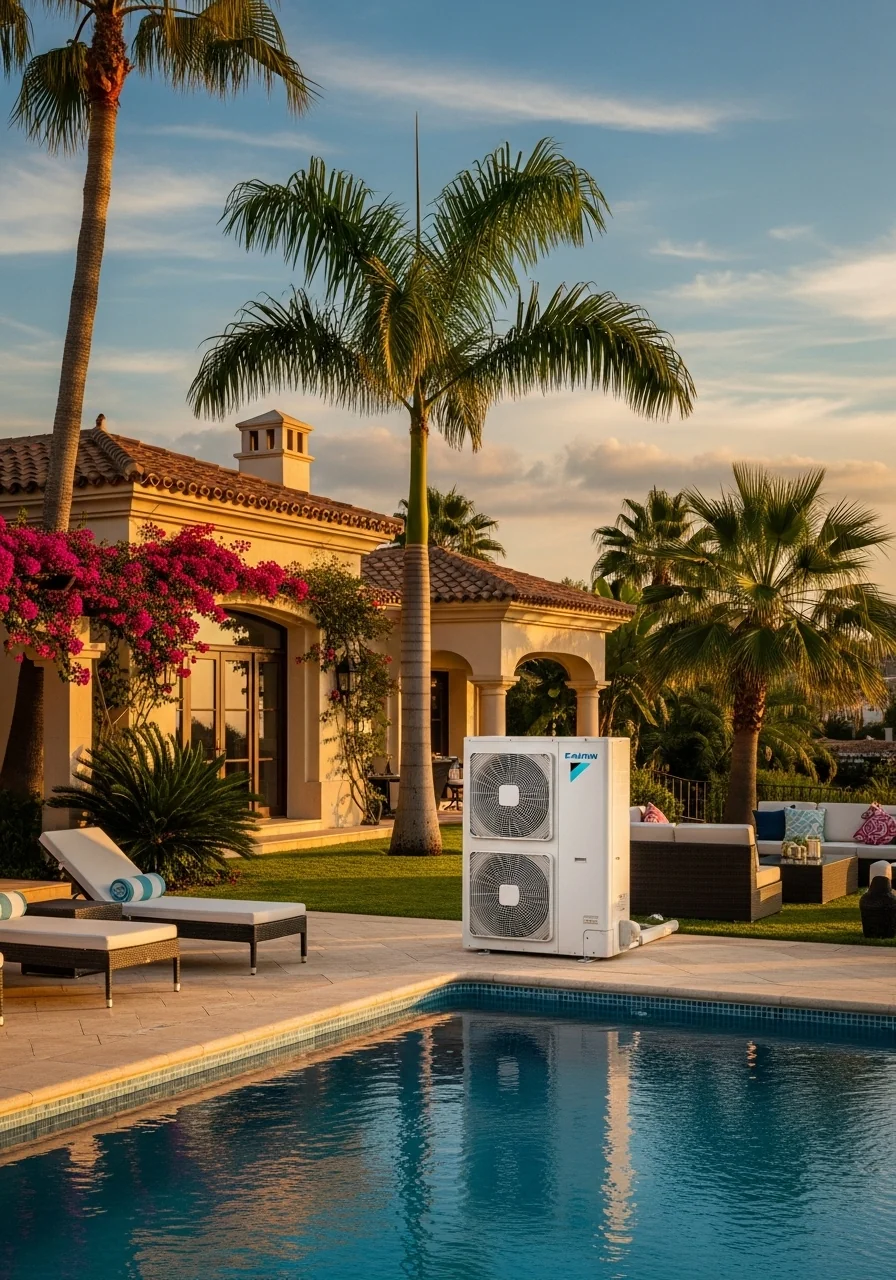
HVAC system sizing for residential properties on the Costa del Sol.
Quick answer
For most Costa del Sol villas, plan for around 60–80 W/m² of cooling capacity. A 200 m² property needs 12–16 kW (40,000–55,000 BTU). The Mediterranean climate reduces peak heating loads, but direct sun and low ceilings on upper floors can raise cooling demand by 20–30 %.
Oversizing = higher costs. Undersizing = poor comfort.
Better insulation allows smaller, more efficient system.
Consider local factors: wind, altitude, microclimate.
Sizing Factors
Impact:
Primary factor - m² determines base load
Calculation:
40-60 BTU per m² typical
Impact:
Can reduce requirements by up to 40%
Calculation:
Multiplies base load by 0.6-1.4
Impact:
South/West add 10-20% load
Calculation:
Adjustment +500-2000 BTU
Impact:
Major impact on solar gain
Calculation:
200-400 BTU per m² of window
Impact:
High ceilings increase volume
Calculation:
+10% for every 30cm above 2.4m
Impact:
Each person adds body heat
Calculation:
400 BTU per person
HVAC System Types
Outdoor + indoor unit
Small to medium homes
SEER 16-20
1 outdoor + multiple indoor units
Multiple rooms
SEER 18-22
Variable refrigerant flow
Large homes, commercial
SEER 20-26
Central system with ductwork
Even distribution
SEER 16-22
Sizing HVAC for the Costa del Sol Climate
Sizing a climate system in Marbella, Fuengirola, Estepona or Mijas is not the same as in northern Europe or inland Spain. The Costa del Sol enjoys over 320 days of sunshine a year, long summers with highs above 30°C from June to September, and mild winters that rarely drop below 8°C. As a result, the cooling load almost always comfortably outweighs the heating load — and a system sized from cold-climate tables ends up oversized for winter and frequently mismatched for summer.
Coastal humidity is the most underestimated factor. Proximity to the Mediterranean keeps relative humidity above 65% in summer, which makes the air feel hotter than the thermometer reads and forces the system to dehumidify as well as cool. An oversized unit chills the air within minutes, shuts off before it can remove moisture and leaves a cold-but-clammy room, while the short cycling wears out the compressor and pushes up running costs. A unit that is too small, on the other hand, will run flat-out through August without ever reaching the target temperature. That is why we recommend a real heat-load calculation (Manual J-style) rather than the quick square-metre rule of thumb.
Property type also changes the outcome. A detached villa catches direct sun on all four elevations, usually has high ceilings, open-plan living and large glazed areas, so it typically needs a multi-split or VRF system split into zones to handle bedrooms, living rooms and daytime areas separately. Penthouses add solar gain through the roof. A mid-sized apartment is shielded by neighbouring units, gains and loses less heat, and is well served by a more compact split or multi-split. Orientation (south and west add load), insulation quality and glazing type then fine-tune the exact capacity — the inputs captured by the calculator above and confirmed during an on-site survey.
About the Author

Ben Hayden
English-Speaking Electrician & Independent Energy Advisor
Ben Hayden is an English speaking electrician and independent energy advisor based in Marbella, Spain, with over 15 years of electrical experience across Europe. He provides independent energy and electrical checks for overseas property owners and managers across the Costa del Sol — helping clients cut electricity bills, navigate Spanish regulations, and make confident decisions on solar PV, heat pump, EV charger and battery storage projects.
Ben advises in plain English on projects where the paperwork is in Spanish and the stakes are high. His writing has appeared in ExpatArrivals, The Olive Press, Euro Weekly News, BuildingTalk and pv magazine.
Need Professional Help?
Our engineers perform precise heat load calculations and select the perfect system for your property.
Free Assessment