

Aerothermal Heat Pumps in Spain: What Costa del Sol Homes Need to Know
Air-to-water and air-to-air systems explained for homeowners
Aerothermal describes heat pumps that exchange heat with outdoor air. Air-to-water can serve compatible wet heating and hot water; air-to-air heats and cools rooms directly. The property, demand, emitters, electrical supply and outdoor location determine the system.
Short answer
What to know before choosing
Aerothermal means a heat pump that exchanges heat with outdoor air. Air-to-water serves compatible wet heating and can produce hot water; air-to-air heats and cools rooms directly. Choose the system type from the property and demand before choosing a brand.
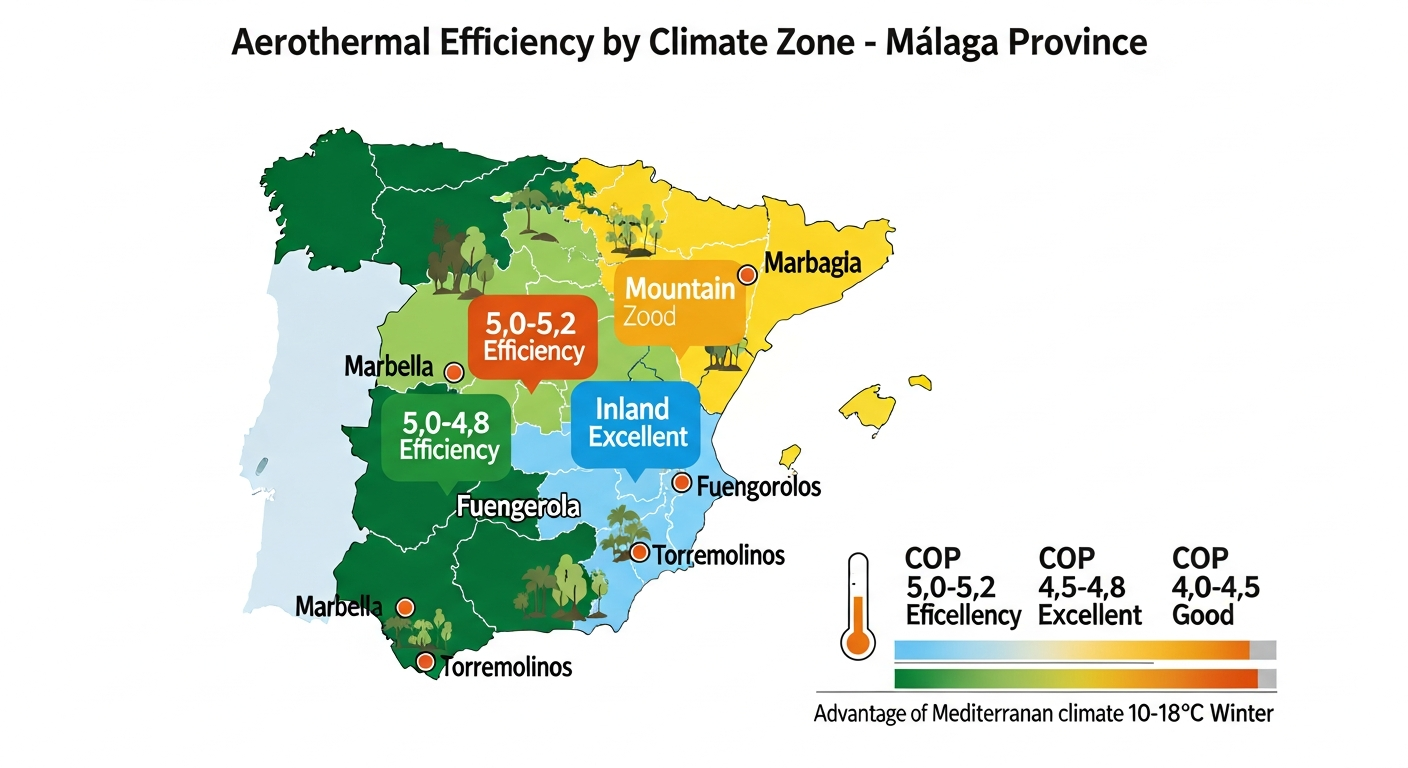
Coastal Málaga conditions, with exposure and colder periods still considered
Capacity comes from heat loss rather than floor area alone
Published efficiency is not treated as a household bill forecast
| Option | Could suit | Check |
|---|---|---|
| Air-to-water | Wet heating and domestic hot water | Heat loss, emitters, cylinder and electrics |
| Air-to-air | Direct zoned heating and cooling | Unit layout, drainage and air distribution |
| Hot-water heat pump | Domestic hot water only | Storage, recovery and plant space |
Costa del Sol homeowner assumptions; not a price, saving, performance or regulatory guarantee.
Quick questions
Is aerothermal the same as air conditioning?
Air-to-air air conditioning is one type of air-source heat pump; air-to-water systems serve compatible wet heating and can produce hot water.
Can aerothermal work with radiators?
It can where radiator output meets room demand at an appropriate water temperature. This must be calculated.
Important disclaimer — Information changes daily
Subsidy amounts, eligibility criteria, deadlines, and programme availability can change without notice. Information on this page is provided as a general guide only and may not reflect the current status of grant programmes.
Agua Therm is an installation company only. We do not handle subsidy applications, IRPF tax deductions, IBI/ICIO municipal applications, or any grant paperwork. We strongly recommend speaking with an independent subsidy specialist before committing to any installation, so you are fully informed of the options available at that time.
What is Aerothermal Energy?
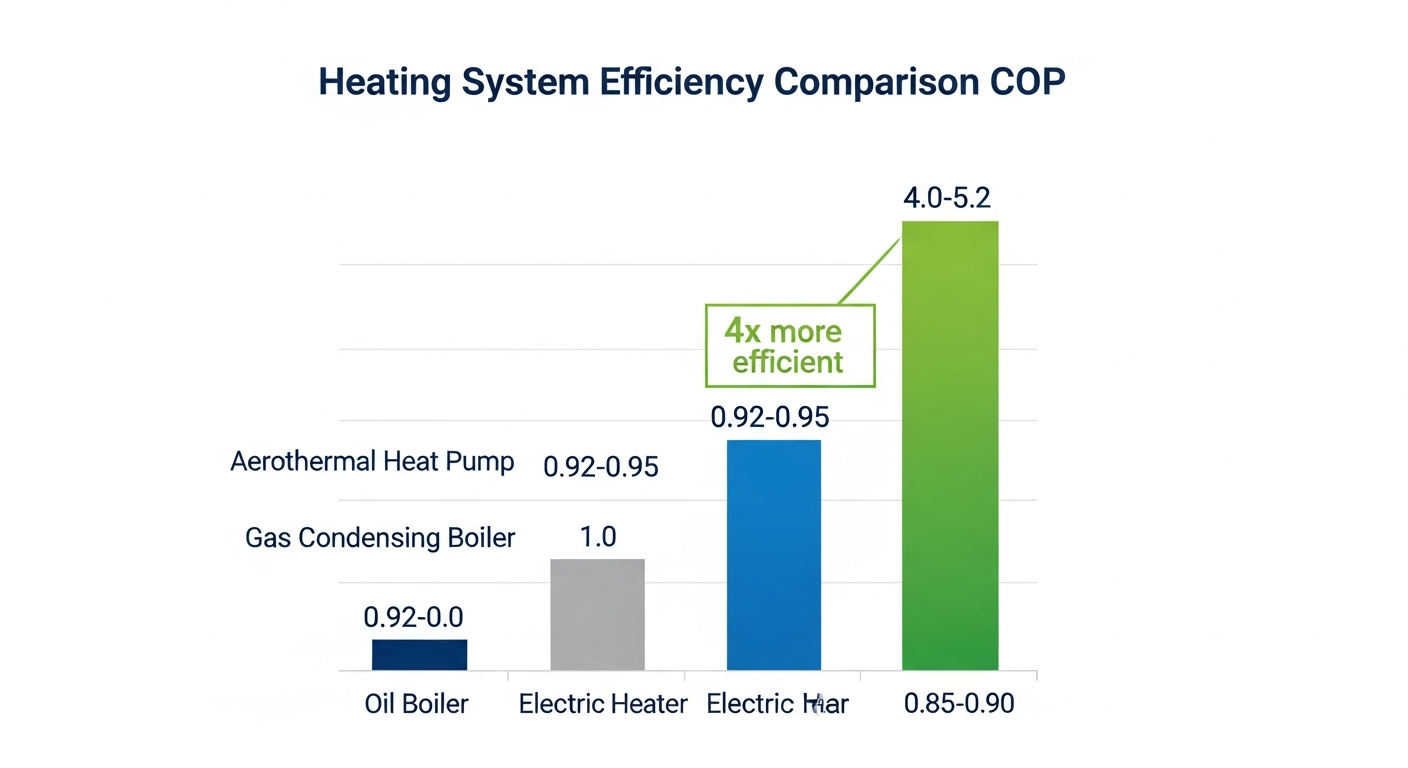
Aerothermal energy (aerotermia) is a revolutionary renewable heating technology that extracts free thermal energy from outdoor air to provide heating, cooling, and hot water for your home. Unlike conventional systems that burn fossil fuels to generate heat, aerothermal heat pumps move existing heat from outside air into your home - achieving 4x the efficiency of traditional gas or oil boilers.
How Aerothermal Technology Works
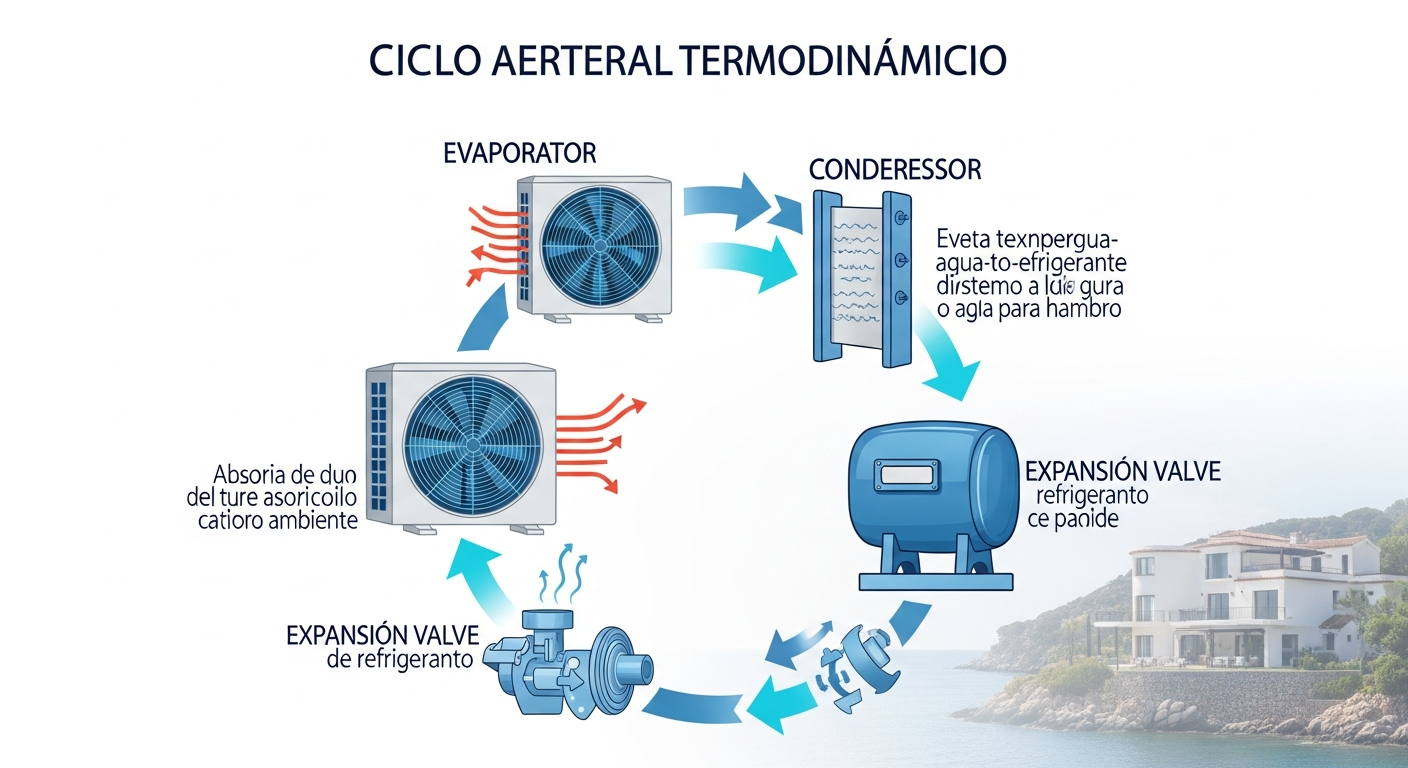
- 1Heat Absorption: Even when outdoor air is cold (down to -15°C), it contains thermal energy. The outdoor unit uses refrigerant in evaporator coils to absorb this heat from ambient air via a fan-driven heat exchanger.
- 2Compression: The refrigerant vapor is compressed using an inverter-driven compressor, significantly increasing its temperature (60-70°C) through pressure increase - this is where the efficiency multiplier happens.
- 3Heat Transfer: The hot refrigerant flows through the indoor heat exchanger (condenser) where it transfers thermal energy to your home's distribution system: water for underfloor heating/radiators (air-to-water) or directly to room air (air-to-air).
- 4Refrigerant Recycling: The cooled refrigerant returns to liquid state via expansion valve and cycles back to the outdoor unit to repeat the process continuously, providing consistent heating or cooling as needed.
- 5Reversible Operation: In summer, the cycle reverses - the system extracts heat from indoor air and releases it outside, providing air conditioning with the same equipment and achieving SEER 6-8 cooling efficiency.
The key to aerothermal's revolutionary 4x efficiency is that it moves heat rather than creating it. For every 1 kW of electricity consumed to power the compressor and fans, the system transfers 4-5.2 kW of thermal energy into your home. This Coefficient of Performance (COP) of 4.0-5.2 is impossible with combustion-based heating, which maxes out at 90-95% efficiency for the best condensing gas boilers.
Air-to-Water vs Air-to-Air Systems
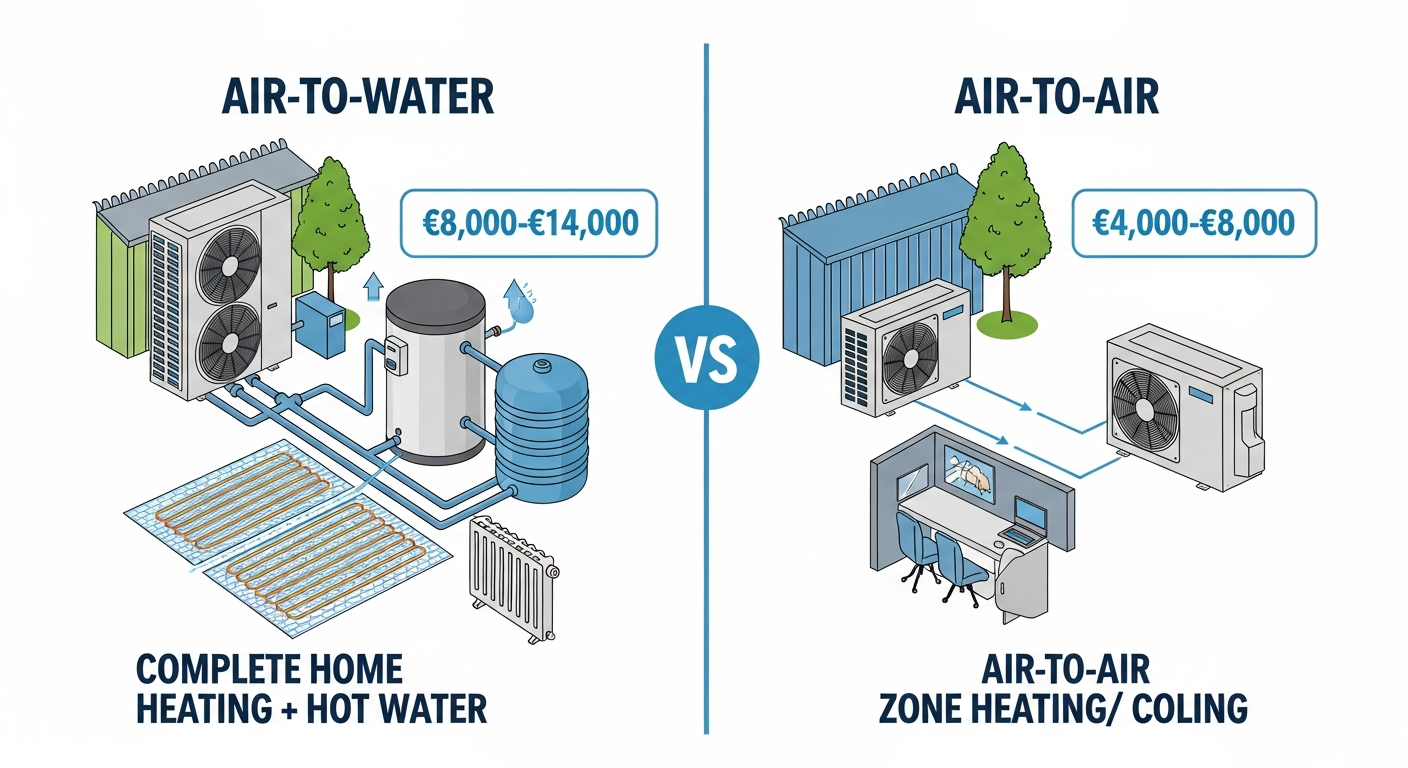
Air-to-Water (Hydronic)
- Heats water circulating through system
- Compatible with underfloor heating
- Works with radiators and fan coils
- Produces domestic hot water (DHW)
- Best for whole-home heating
- Ideal for new construction
- Cost: €8,000-€14,000 installed
Air-to-Air (Ductless)
- Blows heated/cooled air directly
- Mini-split indoor wall units
- Room-by-room zone control
- Cannot produce hot water
- Best for specific zones/retrofits
- Minimal installation disruption
- Cost: €4,000-€8,000 installed
Heat Distribution Systems
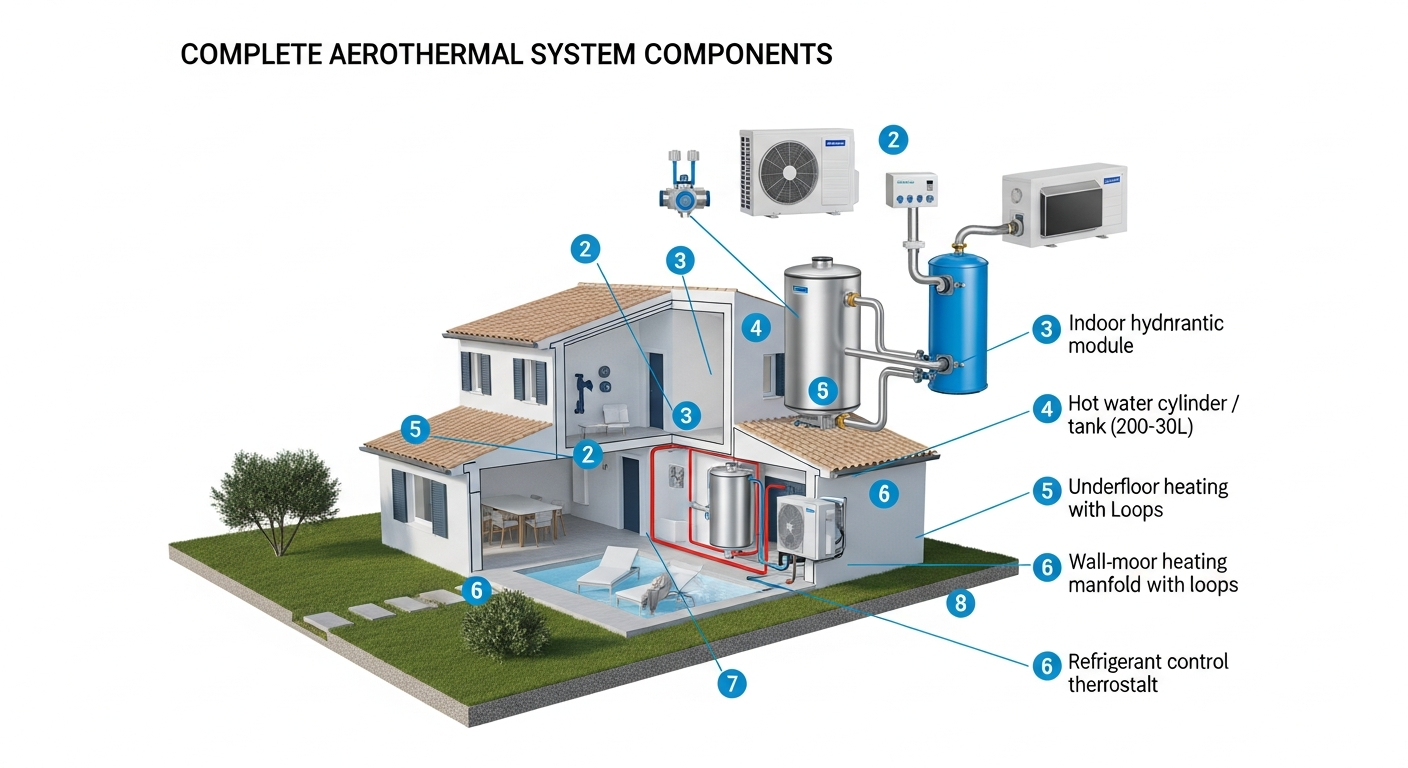
Air-to-water aerothermal systems work with three main distribution methods, each optimized for different home types and renovation scenarios:
1. Underfloor Heating (Suelo Radiante) - Most Efficient
Water circulates through pipes embedded in floor screed at low temperatures (30-45°C). This is the most efficient distribution method because aerothermal systems achieve peak COP 4.8-5.2 at these low supply temperatures. Provides even heat distribution with no visible radiators. Best for new construction or major renovations. Installation cost: €40-70/m² including screed and manifolds.
2. Low-Temperature Radiators - Best for Retrofits
Oversized radiators (30-50% larger surface area) work at 45-55°C supply temperatures for good COP 3.8-4.2. Can sometimes reuse existing radiator locations but often requires radiator upgrades for optimal efficiency. Faster room temperature response than underfloor heating. Best for replacing gas boilers in existing homes. Cost: €150-400 per radiator including pipework modifications.
3. Fan Coils (Ventiloconvectores) - Fast Response
Water-to-air heat exchangers with built-in fans mounted on walls or ceilings. Provides both heating and cooling with rapid temperature changes (room reaches target in 10-15 minutes). Operates at medium temperatures (45-60°C) with COP 3.5-4.0. Requires minimal floor space but visible wall units. Best for commercial applications or homes needing fast zone control. Cost: €400-800 per fan coil unit.
Revolutionary Efficiency & Savings
Aerothermal systems deliver unmatched efficiency compared to traditional heating methods, translating to substantial cost savings and environmental benefits for Spanish homeowners.
| Heating System | Efficiency (COP/SCOP) | Annual Cost | CO₂ Emissions |
|---|---|---|---|
| Aerothermal Heat Pump | 4.0-5.2 | €600-€800 | 0.8-1.2 tons |
| Condensing Gas Boiler | 0.90-0.95 | €1,400-€1,800 | 3.5-4.2 tons |
| Electric Resistance Heating | 0.95-1.0 | €2,400-€3,200 | 2.8-3.5 tons |
| Diesel/Oil Boiler | 0.80-0.85 | €1,800-€2,400 | 4.8-5.5 tons |
*Annual costs based on 150m² home in Málaga province with moderate heating/cooling usage (8,000 kWh thermal demand). Costs include heating, cooling, and hot water.
Average Family Savings with Aerothermal
Annual Savings
Annual Savings
Annual Savings
Environmental Impact: 70% Less CO₂
Aerothermal systems dramatically reduce carbon emissions compared to fossil fuel heating. A typical family home switching from gas boiler to aerothermal prevents 2.7-3.0 tons of CO₂ annually - equivalent to:
- Planting 135 mature trees every year
- Avoiding 15,000 km of car driving annually
- Removing one fossil fuel vehicle from the road entirely
- Meeting personal carbon neutrality goals for home energy
EU 2030 Zero-Emissions Mandate
EU regulations require all new buildings to be zero-emissions by 2030, extending to existing buildings by 2050. Spain's government is accelerating aerothermal adoption (180,000 installations in 2023) to meet these targets:
- January 2026: New public buildings must be zero-emissions
- January 2028: All new residential/commercial buildings zero-emissions
- 2030: Gas boiler bans in new construction across most EU countries
- 2050: All existing buildings must meet zero-emissions standards
Installing aerothermal now future-proofs your property, avoids costly forced retrofits, and qualifies for maximum current subsidies before they decrease.
Installation Cost Guide Spain 2026
Aerothermal installation costs in Spain vary based on property size, system type, and distribution method. Here's a comprehensive breakdown with real examples showing total costs, subsidy reductions, and net investment after government support.
| Property Type | System Size | Installation Cost | System Type |
|---|---|---|---|
| Small Flat (up to 90m²) | 4-6 kW | €4,000-€8,000 | Air-to-air ductless |
| Medium Home (90-150m²) | 6-10 kW | €8,000-€12,000 | Air-to-water + radiators |
| Large Home (150m²+) | 10-16 kW | €10,000-€14,000 | Air-to-water + underfloor |
| Geothermal System | 6-12 kW | €12,000-€22,000 | Ground-source heat pump |
| Hybrid Solutions | 6-10 kW | €9,000-€16,000 | Aerothermal + backup system |
Real Installation Examples with Full Cost Breakdown
Property Details:
- • 75m² two-bedroom apartment
- • 4th floor with balcony (outdoor unit placement)
- • Existing radiators replaced with ductless units
- • Moderate insulation (double-glazed windows)
- • Annual heating/cooling demand: 5,500 kWh
System Specifications:
- • Mitsubishi MSZ-LN25 air-to-air
- • 2.5 kW heating/3.5 kW cooling capacity
- • COP 5.0 / SEER 7.5
- • 2 indoor ductless units + 1 outdoor compressor
- • Whisper-quiet operation 19 dB indoor
Cost Breakdown:
Agua Therm does not process subsidies — we are installers
IDAE grant applications, IRPF tax deductions, and IBI/ICIO rebates must be processed by you or an independent specialist subsidy company. Agua Therm will provide all the installation documentation you need (invoices, installation certificate, technical specs) for your application.
See our list of verified specialist companiesSubsidies & Incentives (amounts shown are estimates):
Property Details:
- • 180m² four-bedroom detached villa
- • Garden with space for outdoor unit
- • New underfloor heating installation throughout
- • Good insulation (A-rated energy certificate target)
- • Annual heating/cooling demand: 11,200 kWh
System Specifications:
- • Daikin Altherma 3 air-to-water
- • 12 kW heating/cooling capacity
- • COP 5.2 / SEER 8.2
- • 300L DHW tank for hot water
- • Smart thermostat with zone control
Cost Breakdown:
Subsidies & Incentives:
Property Details:
- • 140m² three-bedroom townhouse
- • South-facing roof (optimal solar)
- • Existing radiators (low-temp compatible)
- • Moderate insulation upgrade included
- • Annual energy demand: 9,800 kWh thermal + 3,500 kWh electric
System Specifications:
- • Carrier AquaSnap 10 kW air-to-water heat pump
- • 5 kW solar PV (15 panels @ 330W)
- • 5 kWh battery storage (LG Chem)
- • Smart energy management system
- • 85% energy independence
Cost Breakdown:
Combined Subsidies & Incentives:
Regional Price Variations
Installation costs vary by region due to market competition and local labor rates:
- Madrid & Barcelona: €4,000-€5,500 for small flats (high competition, lower prices)
- Málaga Province: €4,500-€8,000 for small flats (coastal premium for salt-resistant equipment)
- Rural Areas: Add €500-€1,200 for travel time and logistics to remote municipalities
Article continues with Spain 2026 Subsidies, Municipality Guide, Brand Comparison, Installation Process, and 25-question FAQ...