

Equipment installed on this project

San Pedro de Alcántara: Johnson DC Inverter A++ Split AC — Two-Bedroom Villa Installation
Case Study: Two Johnson R32 DC Inverter Wall Splits with Insulated Copper Linesets, Nitrogen Pressure Test and Full F-Gas Vacuum Commissioning
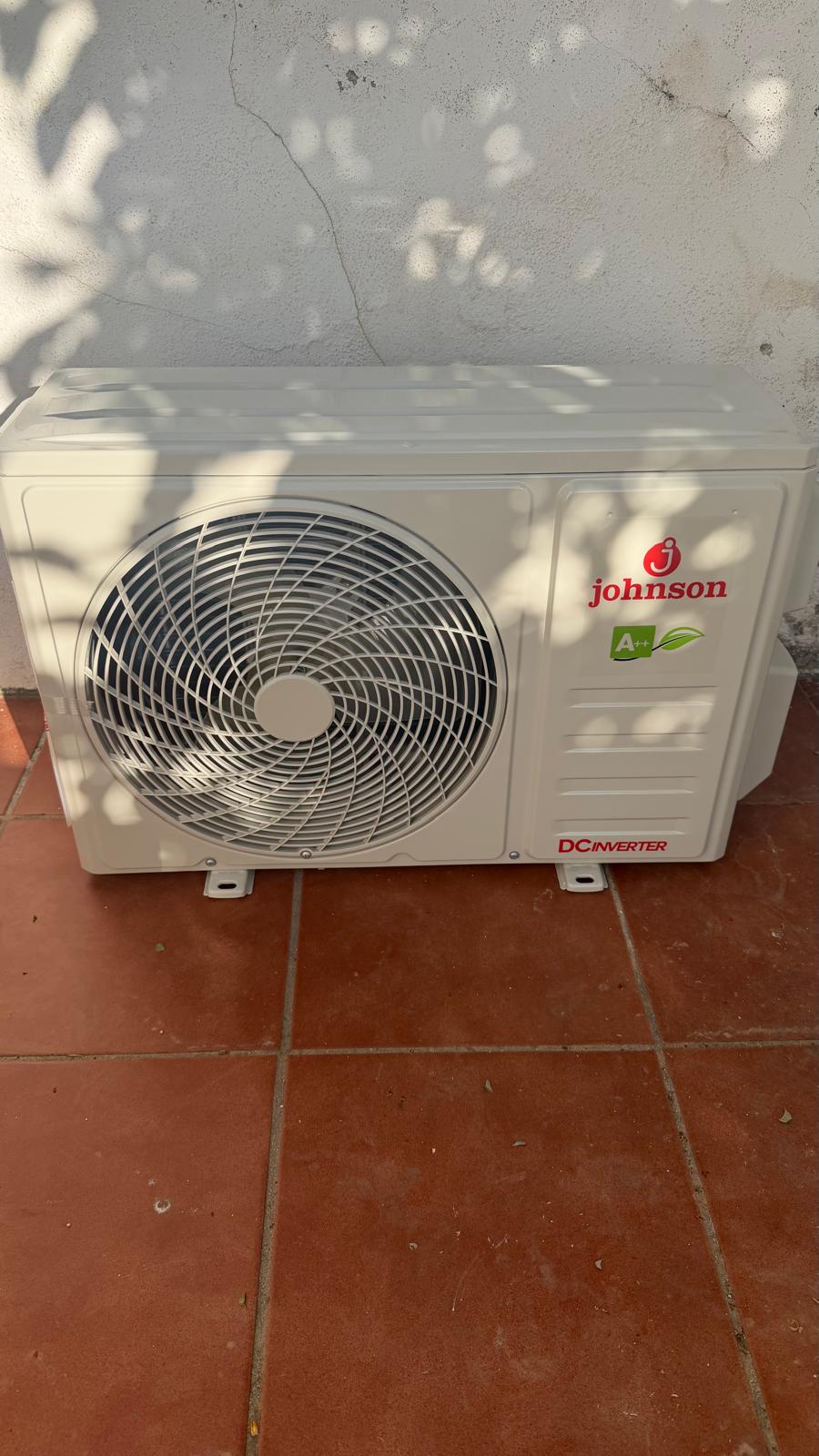
Johnson DC Inverter A++ outdoor unit — Spanish manufactured
_1778130785308-Dv_4jP9I.jpeg)
Indoor unit installed in the master bedroom
_1778130785308-BlpZ3P_v.jpeg)
Second indoor unit — guest bedroom
The Challenge: Retrofit AC into an Existing San Pedro Villa Without Damaging Finishes
The San Pedro de Alcántara villa is a typical Costa del Sol property — masonry walls, painted plaster finishes, terracotta floor tiles and beautifully maintained interior woodwork. The owners wanted reliable, quiet, modern air conditioning in two bedrooms ahead of the summer season but, understandably, did not want a builder's mess. Several site-specific challenges shaped the design:
- Two separate bedrooms on different sides of the villa — a centralised multi-split would have meant longer copper runs, more wall chasing and a single point of failure for both rooms
- Painted plaster walls in pristine condition — bracket layout, level lines and any drilling had to be marked with a Stanley spirit level and core-drilled cleanly to avoid damage
- Outdoor unit positions had to balance airflow clearance, service access and discreet visual integration with the white-rendered villa façade
- Existing 230 V single-phase supply — no scope (or need) for a three-phase upgrade, but each indoor unit needed its own protected spur off the main consumer unit
- Owner wanted A++ efficiency, R32 refrigerant and inverter operation as non-negotiables — no fixed-speed, R410A or budget OEM equipment
- Installation needed to be completed in one working day per room with no overnight downtime in an occupied villa
_1778130785308-BDEvYcpd.jpeg)
Master bedroom before — layout marked and tools in position
_1778130785308-WE7EIq1e.jpeg)
Second bedroom before — painted finish to protect
Our Recommendation: Two Johnson DC Inverter Wall Splits (A++, R32)
After surveying both bedrooms, the proposed outdoor unit positions and the cable route from the consumer unit, our specialists specified two single-split systems rather than a single multi-split. Independent splits give better redundancy, lower copper losses and individual control per room. Here is why Johnson DC Inverter A++ R32 was the correct fit:
Full DC Inverter Compressor — Continuous Modulation
Variable-speed compressor smoothly modulates output from low trim to full power instead of cycling on/off at full load. That means lower running cost, no temperature swing, no compressor inrush and significantly less audible operation than a fixed-speed unit
A++ Energy Class — SEER ≥ 6.1, SCOP ≥ 4.0
Independently rated A++ on the EU energy label for both cooling (SEER) and heating (SCOP). Real-world running costs in San Pedro: a typical bedroom unit costs €0.05–€0.12 per hour to run on cooling at part load — a fraction of the cost of older A or B-rated equipment
R32 Low-GWP Refrigerant
Next-generation refrigerant with a Global Warming Potential of 675 — about 68 % lower than the older R410A (GWP 2,088). Fully compliant with EU Regulation 517/2014 and its 2024 successor (EU) 2024/573, future-proofed for the 2025–2030 phase-down of high-GWP refrigerants
Quiet Operation — Indoor Unit From 19 dB(A)
Indoor unit sound pressure starts at 19 dB(A) on whisper mode — quieter than a library — and the outdoor compressor sits at 50–54 dB(A) at 1 m. Critical for bedrooms where the AC will run overnight on sleep mode
Spanish-Manufactured Brand With Local Parts Support
Johnson is manufactured by EAS Electric Smart Technology, S.L. in Redován (Alicante). Spanish supply chain means parts and warranty support are available locally on the Costa del Sol within days, not weeks — unlike some Asian-imported budget brands
Wide Operating Range, Mediterranean-Optimised
Cooling rated down to 18 °C ambient and heating rated up to 30 °C ambient — perfect for Costa del Sol's mild winter heating and hot summer cooling needs. The same units also run as efficient heat pumps for cool February nights
Refrigerant Pipework: Insulated Copper, Flared Connections, Nitrogen Pressure Test
The refrigerant pipework is the single most important part of any split AC installation — bad pipework loses efficiency, drips condensate inside walls and slowly leaks R32 to atmosphere. We specify and install the pipework to manufacturer specification on every job:
- Pre-insulated copper pipe pairs (1/4" and 3/8" liquid and gas lines) cut to length with a pipe cutter — never a hacksaw — to avoid burrs and metal swarf entering the refrigerant circuit
- Pipe ends deburred, then flared with a precision flare tool to the manufacturer's torque specification — flare faces inspected for cracks or eccentricity before brass union nuts are tightened
- Continuous closed-cell foam insulation maintained over the full pipe run with no gaps — wrapped and taped where the pipework enters the wall to prevent condensation forming inside the cavity
- Insulated condensate drain hose run on a continuous fall to a discrete external discharge point — no shared drains, no internal terminations into bathroom waste pipes
- Flexible electrical interconnect cable bundled with the refrigerant pipes inside spiral wrap so the entire lineset is one tidy run from outdoor unit to indoor unit
- Wall penetrations sleeved and sealed with weather-resistant mastic on the outside face to keep wind-driven rain and insects out of the cavity
_1778130785308-Dd_7uFfY.jpeg)
Indoor bracket layout with Stanley spirit level
_1778130785308-BlDv295C.jpeg)
Pre-insulated copper with flared connections ready to torque
Electrical Work — Done to REBT, Not Daisy-Chained Off a Socket
Air conditioning units are continuous-duty inductive loads, and they must not be powered from a general lighting or socket circuit — that is one of the most common causes of nuisance tripping, scorched terminals and voided warranties on the Costa del Sol. Our REBT-qualified electricians completed:
- Two new dedicated 230 V single-phase spurs run from the villa's main consumer unit — one for each indoor/outdoor pair — sized for continuous duty including starting current allowance
- Each spur protected by its own Type A 30 mA RCBO (combined MCB + RCD) installed in the existing consumer unit — provides both overcurrent and earth-fault protection on a single device
- Three-core flexible cable routed in PVC conduit, clipped to the wall in compliance with REBT ITC-BT-19 (interior installations) — minimum bend radius respected at every change of direction
- Earth conductor terminated to the outdoor unit chassis and bonded back to the villa's main earth bar — verified with continuity test and recorded on the install certificate
- Insulation resistance test performed before energising — both circuits exceeded 1 MΩ to earth as required by REBT (Reglamento Electrotécnico de Baja Tensión, Real Decreto 842/2002)
- Both circuits clearly labelled at the consumer unit so future electricians and the homeowner know exactly which AC unit each breaker protects
Powering an AC condenser from an existing socket-outlet circuit might 'work' on day one, but the inverter compressor's continuous current draw will eventually cook the socket terminals, trip the lighting RCD nuisance-style on a humid night, or — in the worst case — cause a fire. A dedicated, properly protected spur per unit is the only code-compliant way to install AC in Spain, and it is the only configuration that keeps the manufacturer warranty valid.
F-Gas Commissioning: Nitrogen Pressure Test, Deep Vacuum, Charge Verification
Commissioning is where most installers cut corners — and it is exactly where the long-term performance of the unit is decided. A bottle of nitrogen, a vacuum pump and a Testo digital manifold are non-negotiable on every Agua Therm AC install:
- Refrigerant circuit pressure-tested with dry nitrogen (Air Liquide cylinder, OFN grade) to 30 bar for a minimum 30-minute hold — pressure drop monitored on the digital manifold and logged on the install certificate
- After a successful pressure test, nitrogen released and a deep vacuum pulled to ≤500 microns using a two-stage rotary vacuum pump — held under vacuum for at least 30 minutes to confirm no moisture or non-condensables remain in the circuit
- Service valves opened to release the factory R32 charge into the pipework — sub-cooling and superheat readings verified against manufacturer commissioning chart
- Initial cooling cycle run for at least 20 minutes; supply air temperature, return air temperature and Δ T measured at the indoor unit grille and recorded
- Outdoor unit drainage, defrost cycle (when running in heating) and inverter modulation observed and confirmed normal
- F-Gas certificate issued and the installation logged in the owner's documentation pack — required for any future warranty claim or property sale
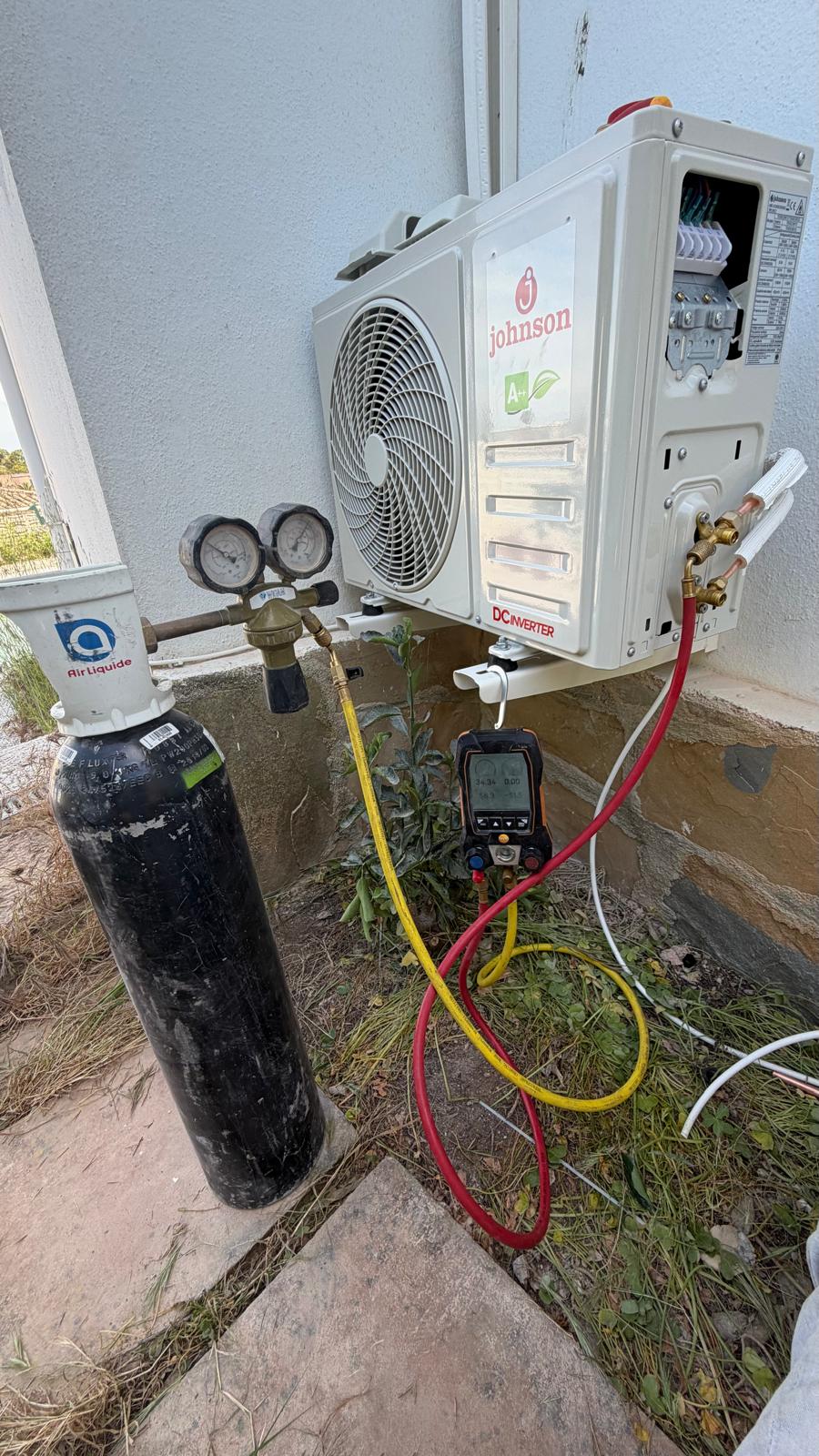
OFN dry nitrogen pressure test — logged on Testo digital manifold
Verified Efficiency Benefits — Backed by Independent Sources
The performance figures for modern A++ R32 split air conditioners are not marketing claims — they are independently verified and consistent with how EU regulators describe contemporary inverter equipment:
A++ on the EU energy label means SEER ≥ 6.1 and SCOP ≥ 4.0
The EU Energy Labelling Regulation defines the A++ band thresholds. A SEER of 6.1 means the unit delivers 6.1 kWh of cooling for every 1 kWh of electricity consumed across a representative seasonal profile — far above older fixed-speed units which typically achieved EER of 2.5–3.0
Source: EU Regulation (EU) 626/2011 — Air Conditioner Energy LabellingR32 has 68 % lower GWP than R410A — and is required by F-Gas
R32 has a GWP of 675 versus 2,088 for R410A. EU Regulation 517/2014 — and its 2024 successor (EU) 2024/573 — drives the phase-down of high-GWP refrigerants. R32 is the long-term standard for new residential split AC in Europe
Source: EU Regulation (EU) 2024/573 on fluorinated greenhouse gasesInverter compressors deliver 30–50 % savings vs fixed-speed AC
Variable-speed compressors run continuously at low load instead of cycling on/off at full power. This eliminates the inrush/cooldown losses of fixed-speed units and is the primary efficiency advantage of modern split AC. The European Heat Pump Association documents this gap across the entire residential range
Source: European Heat Pump Association (EHPA)Nitrogen pressure test is mandatory before charging — EN 378-2
European refrigeration standard EN 378-2 requires the refrigerant circuit to be pressure-tested with an inert gas (typically dry nitrogen) before any refrigerant is released. Skipping this test risks a slow leak that contaminates the atmosphere and voids the manufacturer warranty
Source: EN 378-2 — Refrigerating systems and heat pumps — Safety and environmental requirementsAC use accounts for ~10 % of residential electricity in Costa del Sol
Spain's IDAE energy agency tracks residential air conditioning demand across regions; in coastal Andalucía the share rises significantly above the national average due to longer cooling seasons. Modern A++ R32 inverter equipment is the most effective single intervention to reduce that share
Source: IDAE — Instituto para la Diversificación y Ahorro de la EnergíaAll efficiency figures cited in this case study refer to current Johnson DC Inverter A++ R32 wall-mounted split units as listed on the Johnson product line by EAS Electric Smart Technology, S.L., Redován (Alicante). Specific model SEER/SCOP values vary by capacity and are confirmed on the unit's EU energy label at survey.
"The conventional 'tidy' answer for two bedrooms is a 2×1 multi-split — one outdoor unit, two indoor heads, one set of pipework. On paper it looks elegant. In practice, on a Costa del Sol villa retrofit, two independent single-split systems almost always perform better. You get individual capacity matching to each room, two separate compressors so a fault in one bedroom does not lose the other, shorter copper runs (which means less inverter modulation loss), and you avoid the common multi-split issue where the smaller indoor head over-cools because the compressor is throttled by the larger one. The marginal extra cost of two outdoor units is repaid in the first hot August when one bedroom's compressor lets go and you still have AC in the other room while we get the spare part out. For luxury villa work in San Pedro, Nueva Andalucía and Marbella we recommend independent splits as a default — only spec a multi-split when the outdoor space genuinely cannot accommodate two condensers."

Rob Greeves
HVAC Director, Agua Therm
"Spanish electrical code (REBT) is unusually clear on this point: every fixed appliance over a few hundred watts of continuous load needs its own dedicated circuit back to the consumer unit, with its own protection. People still try to plug a 2.5 kW air conditioning condenser into a 16 A socket-outlet circuit shared with a hairdryer and a phone charger — and the first hot week of June the RCD trips out at 2 a.m. The fix is the same on every job: pull a new 2.5 mm² three-core spur from the consumer unit, terminate it into a properly rated Type A 30 mA RCBO, and label the breaker so the next person knows what it does. We did exactly that for both bedrooms in San Pedro: two independent spurs, two RCBOs, two install certificates. The owner can run both units flat out at 3 a.m. in August and nothing else in the villa even notices."

Craig Whitham
Electrical Director, Agua Therm
_1778130785308-DxcSnbV4.jpeg)
Outdoor unit with clearance for airflow and servicing
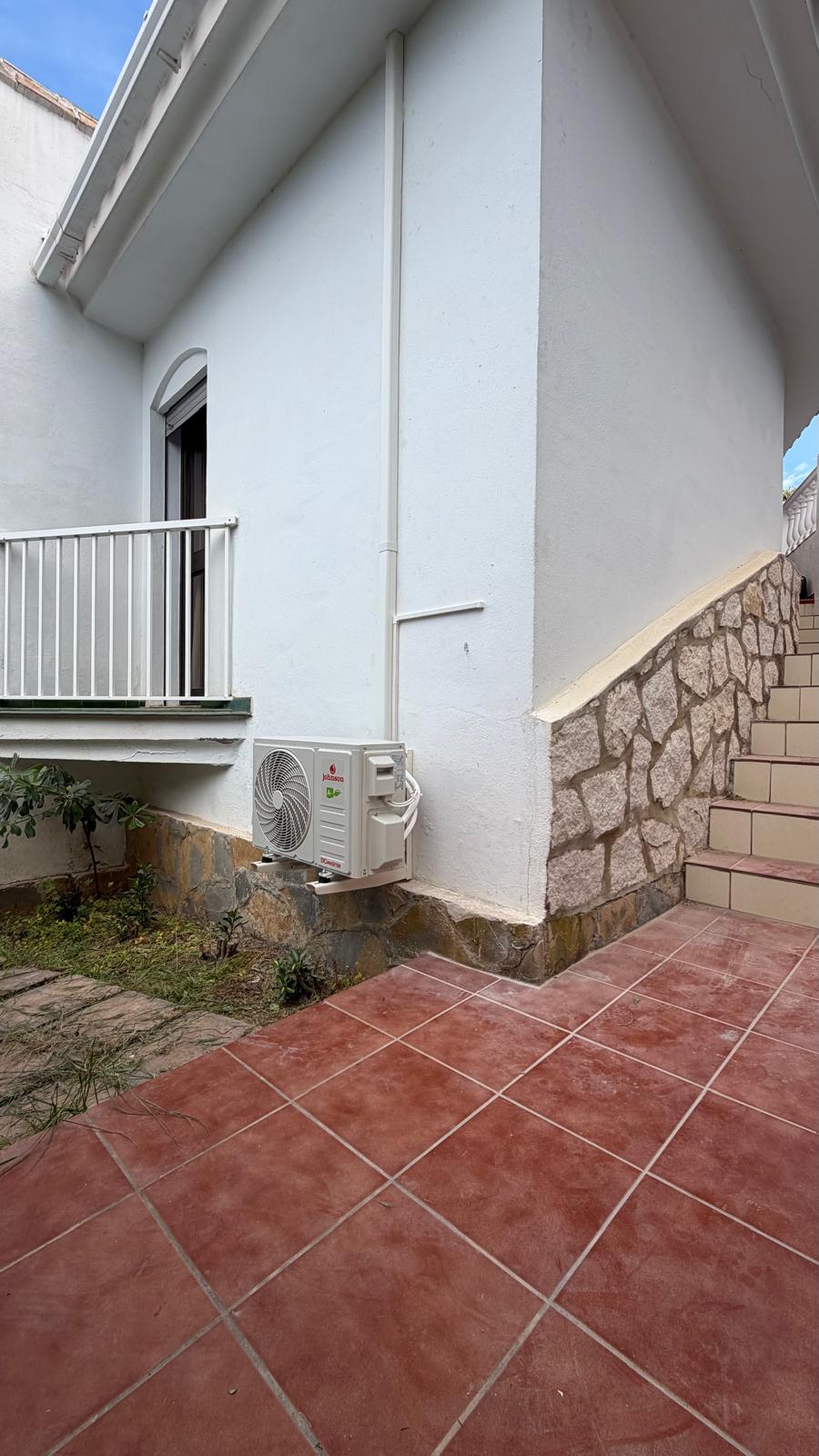
Second outdoor unit discreetly integrated into the façade
Professional Installation Process
Our certified technicians completed the full two-bedroom installation across two working days, working around an occupied villa with minimal disruption:
- 1Site survey of both bedrooms, the proposed outdoor unit positions and the cable route from the main consumer unit
- 2Cooling load calculation for each room based on floor area, glazing, orientation and target setpoint of 24 °C — capacity matched to room load, not over-sized
- 3Indoor bracket positions marked with a Stanley spirit level — bracket fixings drilled into solid masonry, not plasterboard, with stainless-steel plugs and screws
- 4Wall penetrations cleanly core-drilled at a slight outward fall so any condensate drains away from the building, then sleeved and weather-sealed
- 5Pre-insulated 1/4" and 3/8" copper linesets cut to length, deburred, flared and torqued to manufacturer specification — no shared, joined or recovered pipework used
- 6Indoor units mounted on the brackets, levelled, and refrigerant + electrical + condensate connections terminated; condensate drop tested with a jug of water before closing the casing
- 7Two new dedicated 230 V spurs pulled from the villa's consumer unit, each protected by a Type A 30 mA RCBO; earth bonding verified
- 8Refrigerant circuit pressure-tested with OFN dry nitrogen to 30 bar for ≥30 minutes — pressure logged on Testo digital manifold, no decay observed
- 9Deep vacuum pulled to ≤500 microns with a two-stage vacuum pump and held for ≥30 minutes — confirms no moisture or non-condensables in the system
- 10Factory R32 charge released into the pipework via the service valves; sub-cooling, superheat and Δ T verified against manufacturer commissioning chart
- 11F-Gas certificate issued, REBT install certificate completed, owner walkthrough on remote control, sleep mode and filter cleaning
Installation Results
2 × Wall Split
Indoor Units
R32 (GWP 675)
Refrigerant
A++
Energy Class
19 dB(A)
Indoor Noise (low)
Why Johnson DC Inverter AC in San Pedro and the Marbella Corridor?
Johnson (manufactured by EAS Electric Smart Technology, S.L., Redován, Alicante) is one of the strongest mid-market split AC brands in Spain — and the right fit for residential retrofit work in San Pedro de Alcántara, Nueva Andalucía, Puerto Banús and Marbella:
- Spanish-manufactured and -distributed — short supply chain, parts available locally on the Costa del Sol within days rather than weeks
- Full DC inverter technology across the wall-split range, with R32 refrigerant standard on every current model
- A++ energy class on standard residential capacities (9k, 12k, 18k BTU) — independently verified to the EU energy labelling regulation
- Quiet operation — indoor units start at 19 dB(A) and outdoor compressors at 50–54 dB(A) at 1 m, ideal for bedroom installations
- Self-cleaning indoor coil and washable filters as standard — extends service intervals and keeps long-term running cost low
- Smart Wi-Fi compatibility on most current models — schedules, geofencing and away-mode all available without third-party hubs
- Competitive pricing versus equivalent Daikin, Mitsubishi Electric, LG or Samsung A++ wall splits — typically 25–35 % less for comparable capacity and SEER
Location: San Pedro de Alcántara, Costa del Sol
Agua Therm provides professional air conditioning installation throughout the central Costa del Sol corridor, including San Pedro de Alcántara, Nueva Andalucía, Puerto Banús, Marbella, Benahavís, Estepona, Río Real and Las Chapas.
Frequently Asked Questions
Also see
Need Air Conditioning Installed in San Pedro de Alcántara or the Marbella Corridor?
Agua Therm handles the full package: Johnson DC Inverter A++ R32 supply, copper pipework, REBT-compliant electrical spurs, nitrogen pressure test, deep vacuum, F-Gas commissioning and a complete certificate pack. Free site survey anywhere on the Costa del Sol.